Canada | Report: Mehboob Ali Shaikh
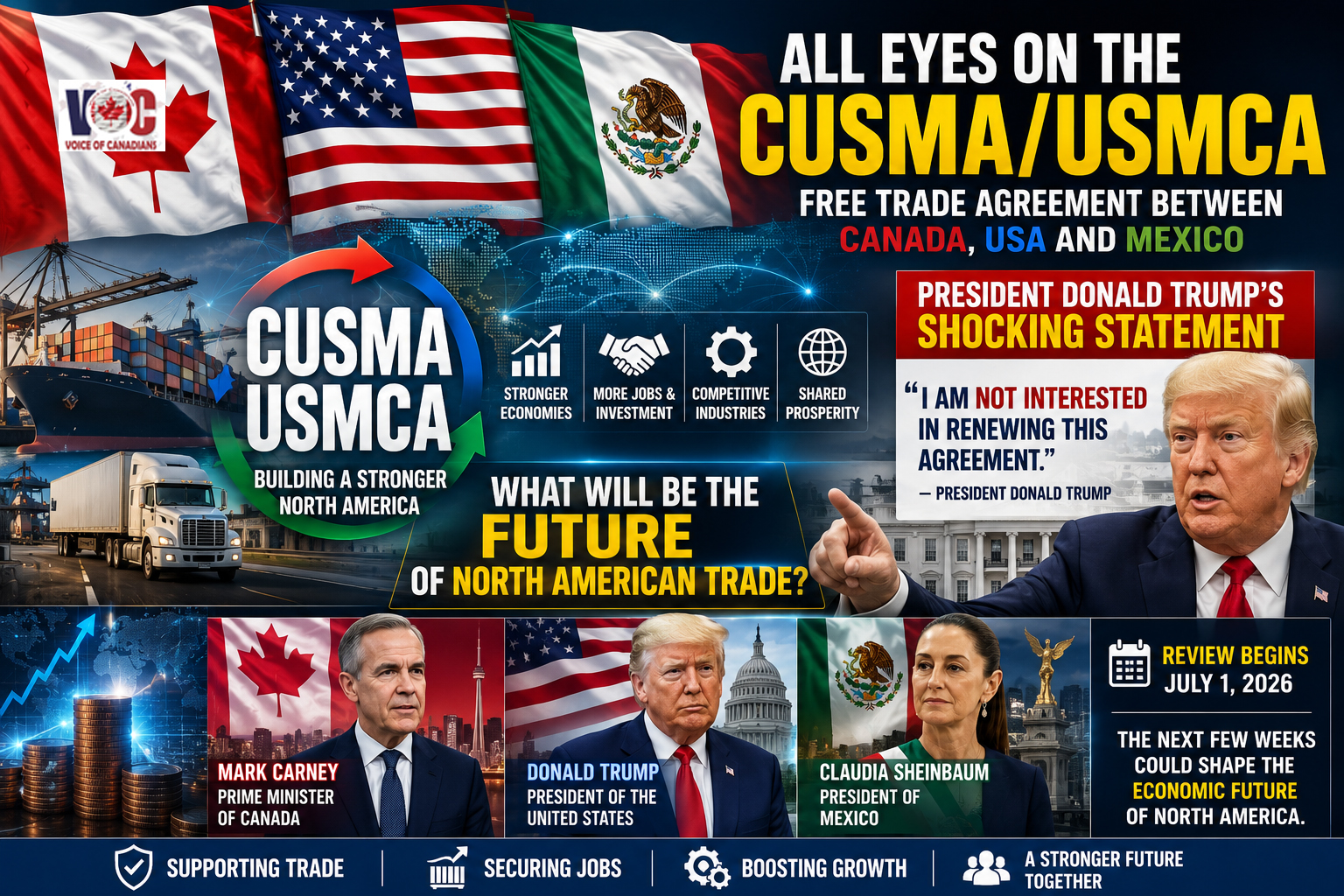
An important debate over the future of North America’s economy has once again moved into the spotlight. Following recent remarks by U.S. President Donald Trump, the CUSMA/USMCA free trade agreement between Canada, the United States, and Mexico has become the focus of international attention.
President Trump raised questions about the agreement’s upcoming review and possible renewal, stating that he is not interested in renewing it. His comments have sparked fresh discussions among investors, business leaders, exporters, and economic experts.
The agreement is scheduled for an official review on July 1, 2026, while Canada has already made it clear that it supports maintaining and renewing the trade framework.
What is CUSMA/USMCA and Why Does It Matter?
CUSMA (Canada–United States–Mexico Agreement) — known as USMCA in the United States — came into effect in 2020.
The agreement replaced the historic NAFTA (North American Free Trade Agreement), which had been in place since 1994.
Its main objectives include:
- Facilitating trade among the three countries
- Reducing customs barriers
- Encouraging investment
- Strengthening supply chains
- Creating jobs and supporting industrial growth
Over recent years, the agreement has played an important role in protecting many Canadian and Mexican exports from significant U.S. import tariffs.
Trump’s Statement — Negotiation Strategy or Signal of Major Change?
Speaking to reporters at the White House, President Trump stated:
“I am not interested in renewing this agreement.”
His remarks came at a time when informal discussions and preparations for the agreement’s scheduled review have already been underway among the three countries for several months.
Trump once again criticized the former NAFTA agreement, calling it:
“One of the worst trade deals in history.”
At the same time, he emphasized that one of the strengths of USMCA is the built-in review and renewal mechanism every six years — a feature his administration previously highlighted because it allows future adjustments and renegotiation if needed.
What Could This Mean for Canada?
Economic experts say that if the United States pushes for major changes or moves away from renewing the agreement, Canada could face significant economic consequences.
Potentially affected sectors include:
- Exports
- Manufacturing
- Automotive industry
- Agriculture
- Industrial investment
- Employment opportunities
A large portion of Canada’s economy remains closely tied to the U.S. market, which is why Ottawa is watching developments very carefully.
Why Is Mexico So Important?
Mexico remains a critical pillar of North America’s supply chain network.
Many Canadian and American companies continue to rely heavily on Mexico for manufacturing and production operations.
If uncertainty around the agreement increases, the impact may extend beyond trade and influence:
- New investments
- Industrial planning
- Logistics
- Employment
- Consumer prices
Why Are the Next Few Weeks So Important?
Economic analysts believe it is still too early to determine whether the United States genuinely intends to reject renewal or whether the comments are part of a broader negotiating strategy aimed at securing more favorable terms.
However, President Trump’s latest remarks have made one thing clear:
The coming weeks could become highly significant for the future of economic relations between Canada, the United States, and Mexico.
Investors, businesses, and exporters are now closely watching the upcoming July 1 review process.
The Big Question
Will North America continue with its current model of free trade, or are the coming months about to open a new chapter in regional economic policy?
That answer is now being awaited not only by the three member countries — but by global markets as well.