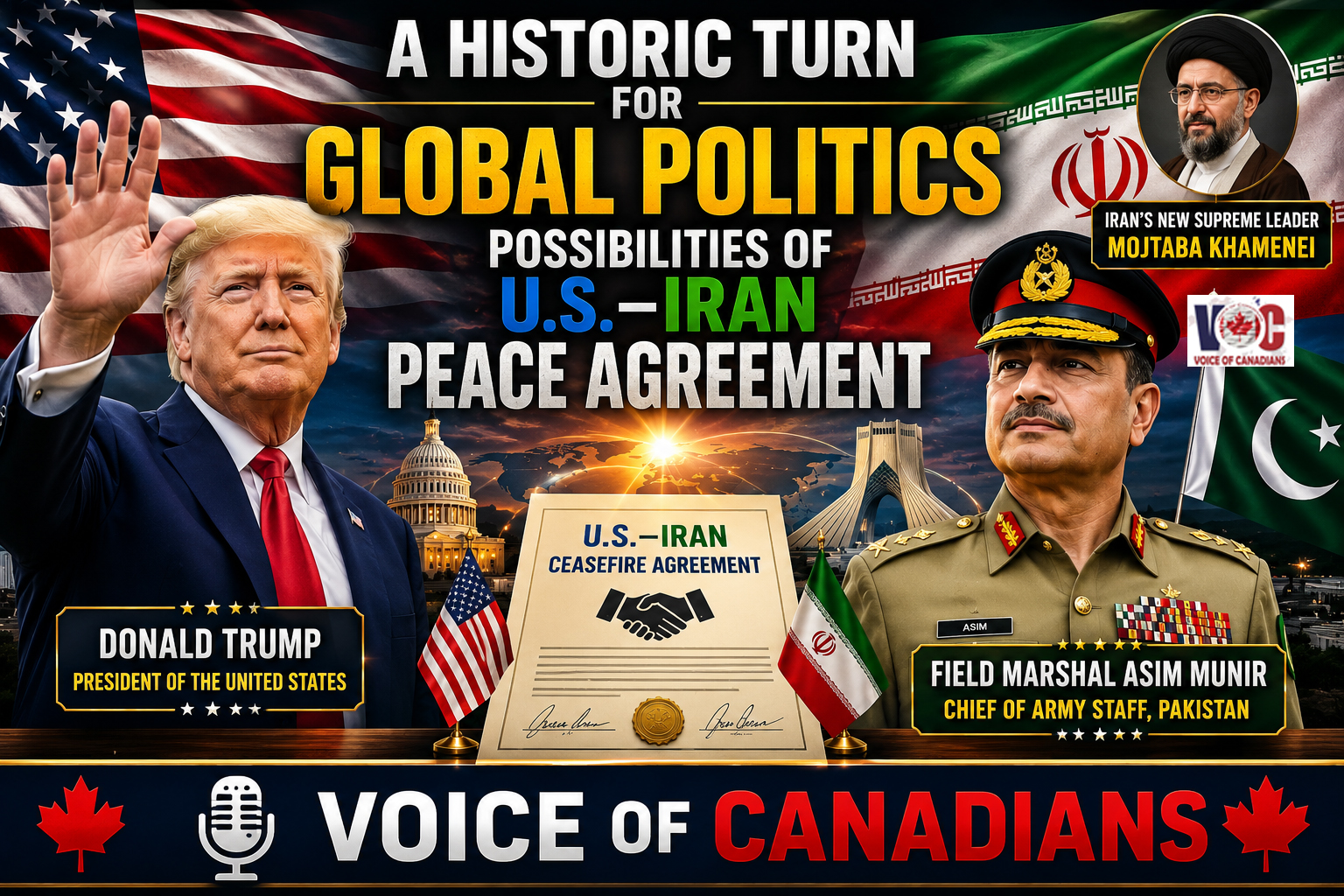
The peace agreement is being described by some commentators as a symbolic gift to global economic stability during U.S. President Donald Trump’s June 14 birthday event.
A new dawn appears to be emerging in the Middle East one that could potentially bring positive effects across the world.
Canada | Report: Mehboob Ali Shaikh
After more than three months of intense tensions and a war-like atmosphere, reports have emerged of a significant peace agreement between the United States and Iran. The development has raised hopes for an end to hostilities and the reopening of the Strait of Hormuz — a move being viewed as potentially important for the global economy.
The Strait of Hormuz is considered one of the world’s most critical oil transit routes, carrying a significant share of global oil and gas shipments. Any disruption to this passage has historically placed pressure on international markets.
Reports indicate progress toward ending hostilities between the United States and Iran and reopening maritime access in the region. U.S. President Donald Trump announced that authorization had been given to end the naval blockade around Iranian ports, while Pakistan has been described as playing a facilitating diplomatic role in the process.
According to analysts, such developments could influence global economic conditions, energy prices, and regional stability in the Middle East. However, Iran’s nuclear program and broader regional security concerns are still expected to remain central issues in future discussions.
President Trump announced the development through social media and stated that approval had been given to end restrictions surrounding Iranian ports.
Economic experts suggest that if the Strait of Hormuz fully reopens, it may contribute to more stable oil prices, reduced shipping costs, and lower inflationary pressure globally.
International sources indicate that Pakistan played an important mediation role, helping restore communication channels and supporting negotiations that eventually moved toward a final stage.
According to Pakistan’s position, an agreement was reached to end military actions immediately and permanently across all fronts, including Lebanon. This development is being viewed by some observers as a notable diplomatic achievement for Pakistan.
Iran has long maintained that any ceasefire arrangement should not remain limited to Iran alone but should also address conflict involving Lebanon.
Reports suggest that despite continued developments in the region, negotiations remained active and Lebanon was ultimately included within the broader understanding.
Although news of a ceasefire and peace understanding has emerged, the core issue — Iran’s nuclear program — remains unresolved.
According to the International Atomic Energy Agency (IAEA), Iran possesses a significant stockpile of uranium enriched up to 60 percent, which remains a major subject of international attention and is expected to be a central issue in future negotiations.
Reports also indicate that the United States may consider easing certain economic sanctions to allow Iran greater room to increase oil exports.
Iran’s economy has faced years of sanctions, inflation, and financial pressure, meaning such developments may offer hope for economic relief among ordinary citizens.
At the same time, some political voices in Israel and the United States have expressed serious concerns regarding any agreement.
Critics argue that if Iran’s missile capabilities, regional alliances, and nuclear activities remain unchanged, any agreement may provide only temporary calm rather than lasting peace.
The history of the Middle East has often shown that the distance between conflict and peace can be very short.
For this reason, observers around the world are viewing these developments with cautious optimism.
If successful, such progress could influence not only regional stability but also global energy markets, trade, investment, and international diplomacy for years to come.