More than 6,100 Citizenship Certificates Issued — 51% Were Born in the United States
Major Increase in Citizenship-by-Descent Claims Following Bill C-3 — More Than 121,800 Applications Pending, Processing Time Reaches Approximately 25 Months
Report: Mehboob Ali Shaikh
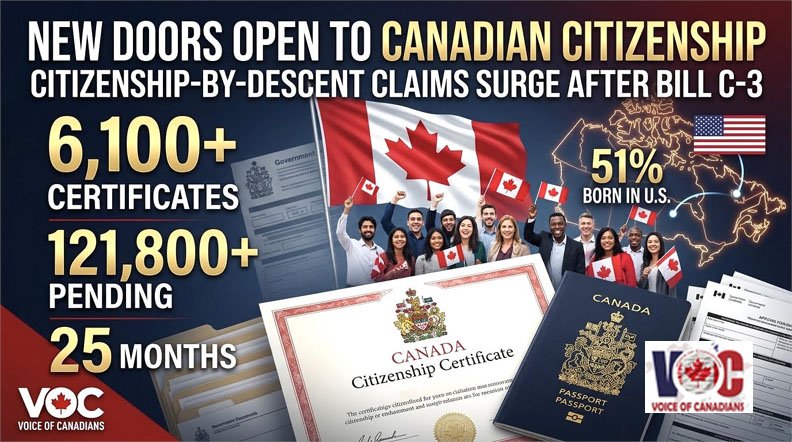
Following a historic change to Canada’s citizenship laws, new doors to Canadian citizenship have opened for thousands of people. Under the new rules, more than 6,100 Citizenship Certificates have been issued, with approximately 51% of the approved cases involving people born in the United States.
This major change follows the implementation of Bill C-3, which came into effect on December 15, 2025. The new legislation significantly changed the previous First-Generation Limit on the transmission of citizenship to people born outside Canada. As a result, a pathway has opened for certain individuals born abroad in the second and subsequent generations to establish their Canadian citizenship.
United States Leads, Mexico Ranks Second
According to IRCC data through May 31, 2026, among Citizenship Certificate cases approved under the expanded rules:
- United States: 51%
- Mexico: 20.5%
- Bolivia: 6.1%
- United Kingdom and its territories: 3.2%
- Belize: 2.2%
These figures indicate that, so far, the law change has had a significant impact on families living in North and South America whose ancestral roots can be traced back to Canada at some point in their family history.
Having a Canadian Ancestor Alone Is Not Enough
An important misconception has also emerged following the new legislation. Simply knowing that someone in your family was once Canadian is not enough to establish citizenship.
Applicants may be required to prove a complete legal and documentary chain of descent linking them to their Canadian parent, grandparent, great-grandparent, or another relevant parental ancestor.
Government records relating to birth, marriage, parentage and historical Canadian citizenship may be required. In other words, finding your genealogy is only the first step; the real challenge is legally connecting each generation to the next.
Receiving a Citizenship Certificate Does Not Necessarily Mean Becoming a Citizen That Day
Receiving a Citizenship Certificate does not necessarily mean that an individual becomes a Canadian citizen on the day the certificate is issued. In certain cases, the individual may already be a Canadian citizen under the law, while the Citizenship Certificate serves as official proof of that citizenship.
Therefore, anyone who believes they may have acquired Canadian citizenship under the new rules should go through the Proof of Canadian Citizenship process to formally establish their status.
The New Law Does Not Create Unlimited Automatic Citizenship for Every Future Generation
The new legislation does not mean that every future generation born outside Canada will automatically receive unlimited Canadian citizenship.
For certain children born outside Canada on or after December 15, 2025, where the Canadian parent was also born outside Canada, the Canadian parent may need to demonstrate a substantial connection to Canada by proving that they were physically present in Canada for at least 1,095 days — approximately three years — before the child’s birth.
Citizenship Certificate Applications Surge
Following the new legislation, Citizenship Certificate applications have increased significantly. According to reporting available in August 2026, the processing time has reached approximately 25 months, compared with about 12 months in May and approximately 19 months in July.
Available figures indicate that approximately 121,800 Citizenship Certificate applications are currently awaiting a decision. These include not only people newly eligible under Bill C-3, but also replacement certificates and other proof-of-citizenship cases.
Applicants applying from outside Canada and the United States may also face additional delays because of mailing and other processing requirements.
Growing Interest Among Americans
The fact that people born in the United States account for approximately 51% of approved cases is one of the most notable aspects of the change.
Experts have linked the growing interest among U.S.-based applicants to a combination of factors, including the current political and geopolitical environment in the United States and the historic changes to Canada’s citizenship-by-descent rules.
However, this is an expert interpretation rather than an official government conclusion. The personal reasons why individual applicants seek to establish Canadian citizenship can vary considerably.
Acadian Families Also Have a Historic Connection
Another interesting historical aspect of the legislation involves American families of Acadian ancestry.
During the 18th century, many French-speaking Acadians were expelled from what is now the Canadian Maritimes and later settled in various parts of the United States, particularly Louisiana.
For some descendants of these families, documenting their historical Canadian ancestry may now have renewed significance.
A Citizenship Certificate Is Not a Passport
Another important point is that a Citizenship Certificate is not a travel document or passport. It is a primary official document used to prove Canadian citizenship. An eligible individual can use proof of citizenship to apply for a Canadian passport and other related services.
If your father, mother, grandfather, grandmother, or an earlier ancestor was Canadian, you should not automatically assume that you are a Canadian citizen based solely on family history.
Historical citizenship laws, the legal status of each generation, renunciation, revocation and other legal factors may affect the outcome.
The safest approach is to first review the official IRCC eligibility information, gather your ancestry and supporting documents, and, where appropriate, submit a formal Proof of Canadian Citizenship application.
The changes to Canada’s citizenship law have certainly created new hope for thousands of families. But the door to citizenship does not open through ancestry alone it opens through the right legal and documentary evidence.