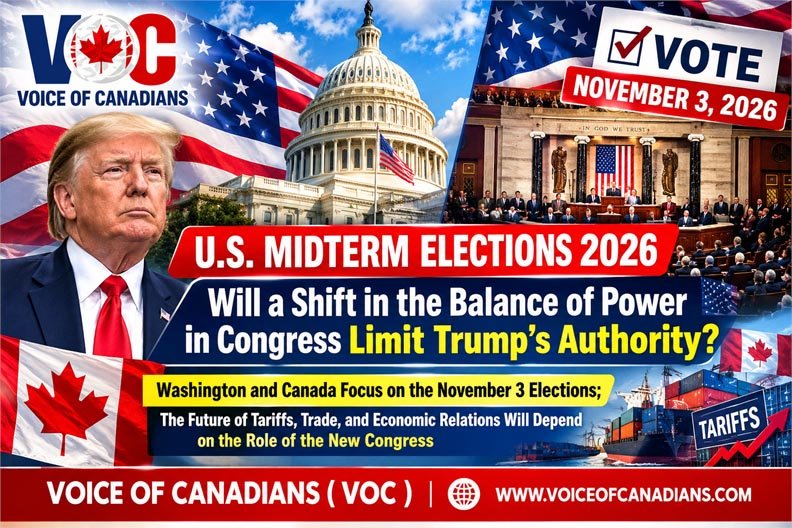
Washington and Canada Focus on the November 3 Elections; The Future of Tariffs, Trade, and Economic Relations Will Depend on the Role of the New Congress
Report: Mehboob Ali Shaikh
The U.S. midterm elections scheduled for November 3, 2026, could play an important role in shaping the political direction of President Donald Trump’s second term over the next two years. All 435 seats in the House of Representatives and approximately one-third of the seats in the Senate will be contested. The election results will be crucial in determining whether the Republican Party retains its majority in Congress or the Democrats succeed in shifting the balance of power.
The significance of these elections extends beyond domestic American politics. They could also have far-reaching implications for trade relations with Canada, import duties (tariffs), industrial production, investment, and cross-border business.
Under the U.S. constitutional system, Congress plays a fundamental role in legislation, approving federal spending, and overseeing the administration. Currently, the Republican Party holds majorities in both chambers of Congress, although its advantage in the House of Representatives is narrow.
According to figures available as of October 14, Republicans held 218 seats in the House of Representatives, Democrats held 214, and one seat belonged to an independent member, while two seats were vacant. In the Senate, Republicans held a majority with 53 seats, while Democrats held 45 seats and two independent senators caucused with them.
If Democrats win a majority in either or both chambers in the elections, the legislative process could become more challenging for President Trump. Congressional oversight of government spending, federal policies, and administrative actions could also become more rigorous.
However, these elections will not end President Trump’s term in office. The next U.S. presidential election will take place in 2028, while the November 2026 results will influence the balance of political power between Congress and the White House.
The Canadian and American economies have deep trade and industrial ties. Cross-border movement of automobiles, steel, aluminum, energy, agricultural products, and various industrial goods is important for businesses and employment in both countries.
Changes or uncertainty in U.S. trade policy could increase costs for Canadian exporters, manufacturers, and investors. Similarly, additional tariffs could affect raw material prices, production costs, and the prices of goods for consumers.
Business communities in Canada are closely watching how trade policies will be scrutinized in Washington after the elections and whether the new Congress will be able to exert effective pressure on the U.S. administration over its tariff measures.
This is one of the key questions surrounding the elections, but the answer is not straightforward. If Democrats gain a majority in Congress, they could hold hearings on trade policies, request relevant documents, and question the administration’s tariff measures. Congress could also attempt to introduce legislation aimed at limiting certain trade powers.
However, an electoral victory for any political party will not automatically eliminate all tariffs imposed by the president. Legislation must pass through the relevant constitutional procedures. If the president vetoes a bill, Congress may also need a two-thirds majority to override that veto.
Therefore, the possibility of Canada receiving meaningful trade relief will depend not only on the election results but also on the actions of the new Congress, the applicable legal powers, and the response of the U.S. administration.
Debate over President Trump’s trade policy is not limited to disagreements between Republicans and Democrats. The potential effects of tariffs are also part of the political discussion in American states that maintain strong economic ties with Canada.
In states such as Michigan, New Hampshire, and Maine, issues including cross-border trade, industrial production, and consumer spending carry electoral significance. Concerns that additional tariffs could increase business costs may pose political challenges for some candidates.
On the other hand, the Trump administration describes tariffs as a measure to protect American industries and respond to unfair trade practices.
This situation demonstrates that the future of U.S. trade policy is closely linked to the balance among different political, industrial, and economic interests.
The future of the North American free trade agreement, known in the United States as the USMCA and in Canada as the CUSMA, is also important for Canada. Trade relations, industrial supply chains, and business activities between the United States, Canada, and Mexico are interconnected under this agreement.
Reviews and negotiations concerning the future of the agreement will play an important role in determining the direction of trade policy in the coming years. In this process, the political priorities of Congress, as well as the positions of the U.S. administration, the Canadian government, and Mexico, will be important.
If trade uncertainty continues, companies may take new measures to change their supply chains, postpone investments, or reduce production costs. Conversely, greater stability in trade rules could help businesses with long-term planning.
If the Republican Party retains its majority in both chambers of Congress, President Trump may continue to have a relatively favorable political environment for advancing his legislative agenda.
If Democrats gain a majority in the House of Representatives or the Senate, disagreements over government oversight, budget negotiations, and legislation could intensify. If the opposing party secures majorities in both chambers, the White House may need to engage in more negotiations and compromises on a range of issues.
Nevertheless, the president’s executive powers will not disappear. Under the American system, Congress, the president, and the judiciary operate within their respective constitutional jurisdictions.
For Canadian observers and business communities, the key issue will not simply be which party wins more seats. It will also be important to examine the size of the majority, the trade priorities of the new Congress, and how the U.S. administration responds to these changes.
In particular, decisions concerning tariffs, industrial trade, energy, cross-border supply chains, and the USMCA/CUSMA will remain important for Canada.
Conclusion: The November 3, 2026, U.S. midterm elections will not determine President Donald Trump’s presidency, but they could reshape the balance of political power during the remainder of his term. For Canada, the real significance of these elections will lie in whether the new political landscape in Washington helps reduce trade tensions, restore business confidence, and promote stability in economic relations between the United States and Canada.
Even after the election results are announced, the full picture will become clear only through the decisions of the new Congress, the actions of the U.S. administration, and progress in trade negotiations between the two countries.