
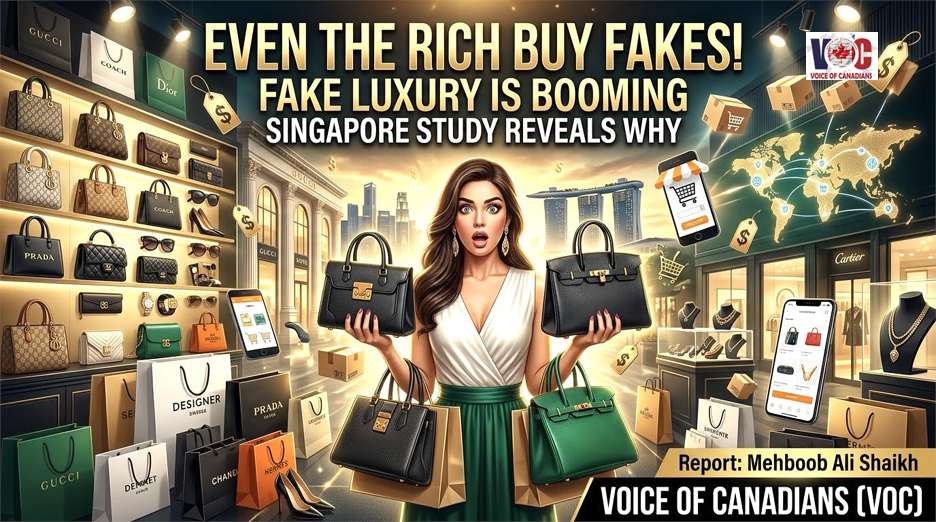
The Global Rise of Fake Luxury, Online Shopping Has Made Counterfeit Fashion More Accessible Than Ever
From Millionaires to Everyday Consumers: Why Are People Replacing Original Luxury Brands with High-End Copies?
Report: Mehboob Ali Shaikh
Do people around the world buy luxury brands worth thousands of dollars simply for appearance and social status? Or is the reality far more surprising?
A new study from Singapore has revealed findings that raise major questions about the global luxury market, online commerce, and consumer behavior.
According to the research, counterfeit luxury products are not only purchased by low-income consumers but are also increasingly being bought by wealthy individuals. Surprisingly, affluent buyers often prefer high-quality replicas that are visually almost indistinguishable from the originals.
Experts say this trend is not just about saving money — it is also linked to social status, psychological pressure, influencing others, and personal identity.
Online trade and global e-commerce platforms have further accelerated this trend. Today, with just a few clicks, consumers can access replica bags, watches, shoes, and clothing inspired by the world’s most expensive brands from the comfort of their homes.
According to a recent Singapore study, high-income consumers are increasingly purchasing counterfeit luxury goods. The study found that wealthy buyers particularly favor premium-quality replicas of expensive brands such as Hermès and Chanel.
Experts suggest this behavior is not driven solely by financial limitations but also by social status, psychological motivations, and the desire to create impressions, while online commerce has made counterfeit products more accessible than ever before.
Across Canada, the United States, India, Pakistan, Europe, and many other countries, online shopping continues to grow rapidly. Chinese markets are flooded with low-cost replicas of the world’s most expensive brands, while social media marketing, international websites, and cross-border shipping have expanded consumer access to products worldwide.
Experts advise consumers not to purchase products based on low prices alone but also to consider authenticity, quality, and legal compliance. Counterfeit products can harm brand owners and may also create quality and safety concerns for consumers.
Traditionally, it was believed that fake luxury goods were purchased only by people who could not afford the originals. However, recent research conducted by the National University of Singapore challenges this assumption.
The study found that both low-income and high-income consumers buy counterfeit luxury products in significant numbers, while middle-income consumers appeared to participate less in this trend.
Researchers analyzed millions of purchases by American consumers involving counterfeit products related to brands such as Hermès, Chanel, and other globally recognized luxury labels.
The findings showed that lower-income consumers tend to buy replicas of relatively affordable luxury brands, while wealthier individuals prefer premium-quality replicas of ultra-expensive brands.
Experts noted that international e-commerce platforms have dramatically increased the availability of counterfeit goods.
Today, consumers anywhere in the world can purchase replica handbags, watches, shoes, clothing, and other luxury items with only a few clicks. As a result, the global counterfeit market continues to expand.
Researchers also found that affluent consumers often buy replicas that closely resemble authentic products and are difficult for ordinary buyers to identify.
According to the lead authors of the study, this phenomenon is not only driven by economic factors but is also strongly connected to social and psychological influences.
People often use luxury brands to communicate social standing, gain acceptance, influence others, and express status. When authentic products become extremely expensive, some consumers attempt to create the same impression through replicas.
Experts involved in the research warned that companies focusing only on low-income consumers as buyers of counterfeit goods may fail to understand the true nature of the issue.
They argue that demand for counterfeit products exists across different economic groups, and therefore brand owners, customs authorities, and law enforcement agencies may need to rethink their strategies.
This research highlights that purchasing counterfeit luxury goods is not simply about financial limitations — it is deeply connected to human psychology, social pressure, and identity.
Today, a brand is no longer just a product; it has become a social symbol.
That is why people from different economic backgrounds whether financially struggling or wealthy sometimes choose counterfeit alternatives to access that symbol.
Experts conclude that brands today represent social power, identity, and influence — and in this race, the line between authentic and imitation products is increasingly becoming blurred.
The question is no longer who buys counterfeit products the real question is why people are choosing copies instead of the world’s most expensive luxury brands.