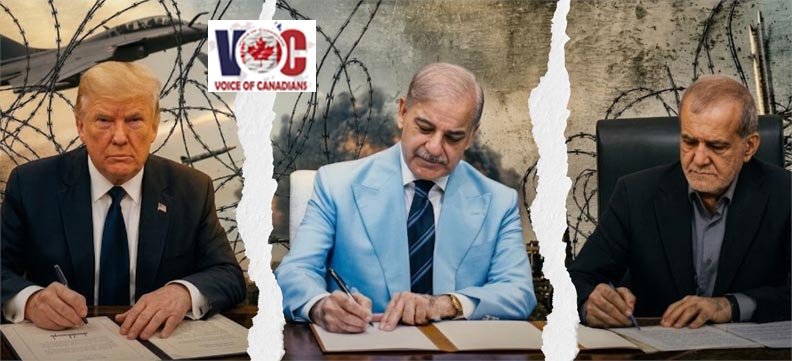
More than 100 days after the United States and Israeli bombs began falling on Iran, Washington and Tehran have “electronically” signed an initial agreement to end their war following efforts primarily by Pakistan and Qatar.
The US and Israel launched the war on Iran, martyring the 86-year-old Supreme Leader Ayatollah Ali Khamenei and military leaders on the first day. It quickly spiralled into a regional conflict that has killed more than 7,000 people, mostly in Iran and Lebanon; driven up energy prices; renewed inflationary pressures and sparked concerns about a major food supply crisis in developing countries.
The 14-point memorandum of understanding, signed separately by US President Donald Trump and Iranian President Masoud Pezeshkian and Prime Minister Shehbaz Sharif as a mediator, sets out a 60-day framework for negotiations over Iran’s nuclear programme but it also confirms an immediate halt to military operations on all fronts, including Lebanon, the reopening of the Strait of Hormuz, lifting of the US naval blockade on Iranian shipping, and a $300 billion investment fund for the Islamic Republic’s post-war reconstruction.
Iran also undertakes not to build nuclear weapons, reaffirming a vow it had made for decades. It also agreed to the on-site “down-blending” of its stockpile of enriched uranium under the supervision of the International Atomic Energy Agency, although Trump had wanted to take it out of the country, which Iran has rejected.Trump chose to formalise it at the Palace of Versailles, the site of the signing of the eponymous treaty that formally ended World War I.
While the initial agreement appears to have ended the fighting and opened the door to diplomacy, the most contentious issues — including Iran’s nuclear programme, uranium enrichment activities and sanctions relief — are to be negotiated over the next 60 days. The current agreement serves as a framework for broader talks rather than a comprehensive settlement.
Geo.tv spoke to Middle East experts and strategic analysts to examine what the initial agreement between Washington and Tehran offers and how it would shape the broader talks, meant to decide the future of the region.
Israel can be a spoiler
Shortly after Trump announced signing the much-awaited deal, Israeli far-right ministers and some lawmakers in the US lambasted the deal that, according to them, failed to curb Iran’s missile programme and provided no clear path to dismantling its nuclear facilities, while constraining Israel in its war with Hezbollah in Lebanon.
Trump has repeatedly criticised longtime ally Israel, spiking tensions nearly four months after the two countries partnered to attack Iran.
Also, Israel, which continues violating the ceasefire in Gaza and Lebanon, even at the time of writing this article, is not a signatory to the memorandum.
Mohammad-Makram Balawi, Director General of the League of Parliamentarians for Al-Quds (LP4Q), believes that under this MoU, to which Israel is not a signatory, the only remaining enforcement mechanism is “American pressure and leverage,” which is typically fragile and does not prevent Israel from executing strikes it claims are vital to its security.
He believes, however, that Trump has a personal incentive to hold Israel back — at least temporarily. “The US president is interested in buying a 60-day cooling-off period because he has his eyes set on the US midterm elections. The continued fallout of the war harms the global economy and his party’s prospects.”