Prime Minister Mark Carney Received A Standing OvationFrom Members of the European Parliament.
Report By: Mehboob Ali Shaikh
Canada and European Union relations could enter a new phase.
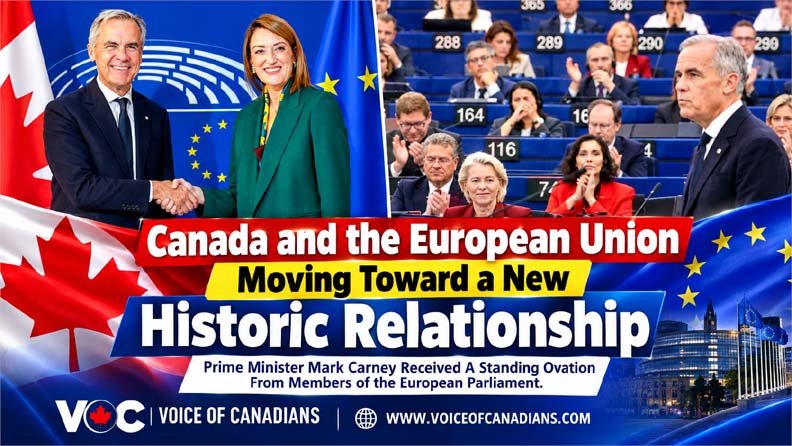
Prime Minister Mark Carney received a standing ovation from Members of the European Parliament during his historic address in Strasbourg.
Prime Minister Mark Carney has welcomed European Commission President Ursula von der Leyen’s idea of making Canada the EU’s first “Associate Member,” while Carney has made clear that Canada is not seeking full European Union membership and that the final legal form of the new partnership has yet to be determined. The final framework will go through debate and a vote in the Canadian Parliament.
Addressing the European Parliament in Strasbourg, France, Canadian Prime Minister Mark Carney welcomed European Commission President Ursula von der Leyen’s proposal to explore a path toward making Canada the European Union’s first “Associate Member” in the future. In her State of the European Union speech on September 16, von der Leyen said Europe wants to move beyond its existing CETA trade relationship with Canada and establish a broader Alliance for the Future.
Carney told European lawmakers that Canada and Europe are not merely fair-weather allies and that they share common ground in values such as the rule of law, democracy, individual freedom and human dignity. He described the proposed cooperation as collective resilience rather than the creation of a new great power or a third rival bloc.
Carney later clarified that Canada is not seeking to become a full member of the European Union. According to him, the final form, name and legal scope of the proposed relationship have yet to be determined. He also said that once the final structure is presented, it will be debated in the Canadian Parliament and ultimately put to a vote. Therefore, it would not be accurate to regard the current stage as full EU membership.
The proposed alliance is not limited to trade. Canadian and European leaders have discussed developing deeper cooperation in critical minerals, artificial intelligence, the defence industry, energy, advanced technologies, research, space, financial services and secure supply chains.
He proposed stronger cooperation on critical minerals, defence, AI, energy security, digital trade, financial services and youth mobility.
In his speech, Carney presented the new partnership as an effort to make Canadian sovereignty more resilient rather than reduce it. His argument was that in the modern era, sovereignty is not limited to food, energy or defence, but also requires secure access to AI, semiconductors, critical minerals, payment systems, clean-energy technology and space-based communications. According to him, Canada and Europe can work together in these areas to reduce vulnerabilities.
Mark Carney declared Canada and Europe are each strong. Europe and Canada are stronger together
The European Commission has avoided describing the new partnership as an initiative against a third country. In her speech, von der Leyen described it as a plan for the shared strength of Canada and Europe, economic security and a partnership for the future. According to Reuters, European officials also emphasized that the plan is not being presented as an alliance against any country.
Attention will now turn to the Canada–EU Summit expected to take place in Montreal on October 29 and 30, 2026, where the practical details of the new relationship are expected to become clearer. Until then, it is more accurate to view “Associate Membership” as a political proposal and a framework under discussion rather than a completed agreement.
Meanwhile, U.S. President Donald Trump has warned that heavy tariffs could be imposed on Europe if the move is considered to be maliciously directed against the United States. Canada and Europe are considering deeper cooperation in several areas, including AI, defence, critical minerals, energy, research and youth mobility.