Special Report: Mehboob Ali Shaikh
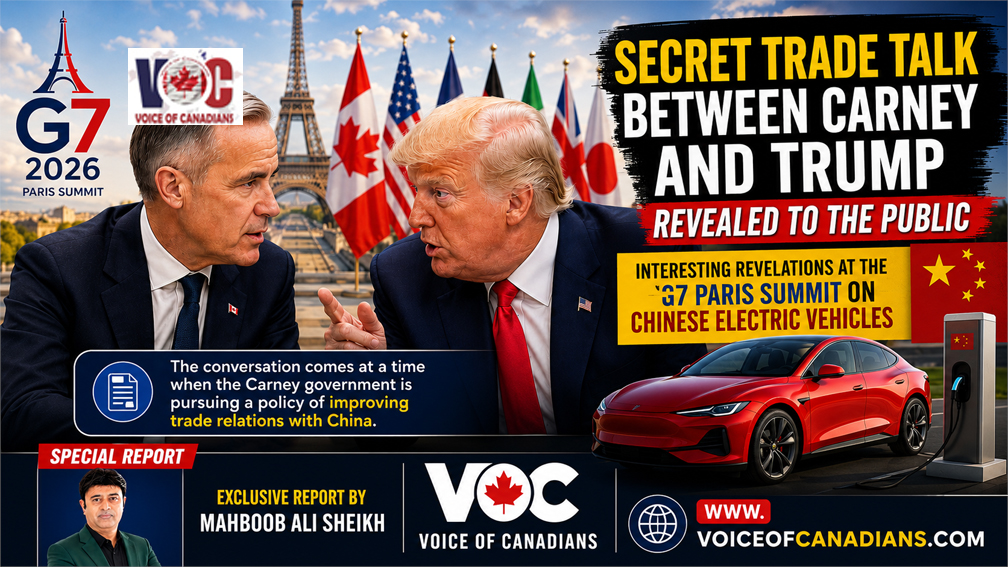
During the G7 Summit in France, an unexpected moment captured global media attention when a conversation between Canadian Prime Minister Mark Carney and U.S. President Donald Trump was picked up by a microphone. The discussion appeared to focus on Chinese-made electric vehicles (EVs), sparking fresh debate not only in Canada but also across the United States, China, and international trade circles.
According to the conversation recorded by cameras and microphones, Prime Minister Mark Carney was heard telling President Trump:
This represents less than three percent of our market approximately 49,000 vehicles.
Mark Carney later clarified with a hand gesture that this figure was set as a “cap” or annual limit. According to him, Canada would allow a maximum of 49,000 Chinese-made electric vehicles into the country each year.
President Trump responded positively, saying That’s good. I like it.
This brief exchange quickly gained significance in the context of global trade policy.
During Prime Minister Carney’s visit to China in January 2026, a trade arrangement was introduced that marked a notable shift from previous policies.
Under this arrangement:
- Canada’s tariff on Chinese EVs was reduced from 100% to 6.1%.
- A limited number of Chinese vehicles were granted access to the Canadian market.
- China significantly reduced tariffs on Canadian agricultural and seafood products.
- Canadian canola exporters received major relief.
The Carney government maintains that this agreement serves the interests of Canadian farmers, exporters, and consumers.
The United States continues to maintain heavy tariffs on Chinese electric vehicles. During former Prime Minister Justin Trudeau’s administration, Canada had also adopted stricter measures aligned with the U.S. position.
However, since taking office, Mark Carney has sought to rebuild warmer economic ties with China. Critics argue that this approach could affect Canada–U.S. trade relations.
Earlier this year, U.S. Commerce Secretary Howard Lutnick warned that Canada could be entering uncertain territory by expanding ties with China without fully considering long-term consequences.
He suggested that if Canada further deepens trade relations with China, the Canada–United States–Mexico Agreement (CUSMA) could eventually face pressure.
Traditionally, the G7 Summit focuses on topics including the global economy, security, energy, and trade.
This year, major discussion points include:
- U.S.–China tensions
- The future of supply chains
- The global electric vehicle market
- Industrial competitiveness in North America
Observers believe the short exchange between Carney and Trump reflects these broader economic debates.
Canada’s Minister for Canada–U.S. Trade, Dominic LeBlanc, later told reporters that the Prime Minister did not reveal any new information.
According to LeBlanc, the Prime Minister merely reminded President Trump about details of an agreement that had already been public for several months. He added that the conversation was only one of many trade-related topics discussed.
Economic analysts suggest that if this policy succeeds:
- Canada’s green economy could strengthen
- Consumers may gain access to more affordable EVs
- Farmers and exporters could benefit from improved access to the Chinese market
- Canada–China relations could improve
On the other hand, critics argue:
- The U.S. government may express concerns
- Canada’s auto industry could face increased competitive pressure
- National security circles remain cautious about growing Chinese influence
- Future trade negotiations could become more complex
The few seconds of recorded conversation at the G7 Summit reflect broader shifts underway in the global economy.
Mark Carney’s strategy of opening a trade window with China combined with Donald Trump’s relatively positive response may indicate that relations among North America, China, and the global EV market could be entering a new phase.
This discussion surfaced as the Carney government continues pursuing policies aimed at improving trade relations with China.
According to experts, the policy could benefit consumers and exporters, although its impact on Canada–U.S. trade relations continues to be closely evaluated.