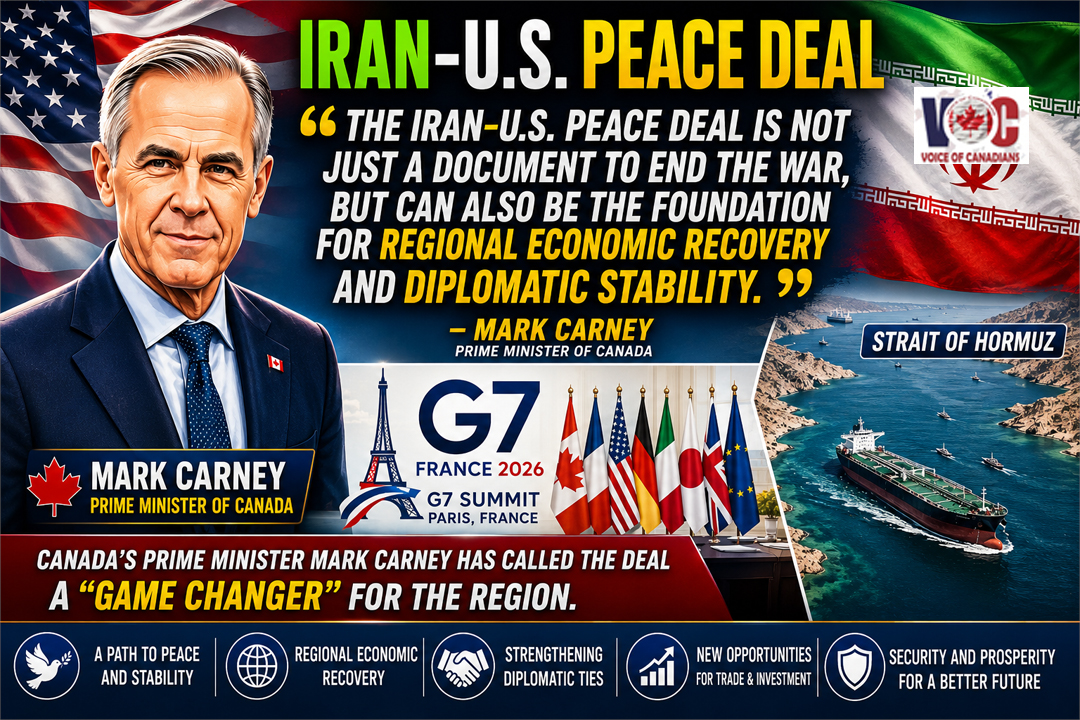
Canada’s Prime Minister Mark Carney has described the agreement as a “game changer” for the region.
A formal signing ceremony of the agreement is expected in Geneva on Friday, after which negotiations on a permanent peace accord will continue.
Special Report: Mehboob Shaikh
Following a temporary peace agreement between Iran and the United States, Canada’s Prime Minister Mark Carney stated that if the agreement ultimately removes the possibility of Iran acquiring nuclear weapons, then the conflict was “worth it.” He described the agreement as a potential “game changer” for the region.
Under the framework, the 60-day ceasefire would be extended while negotiations continue toward a permanent peace arrangement. The reopening of the Strait of Hormuz, regional stability, and economic cooperation are being described as key benefits of the agreement, although implementation will remain the true measure of success.
After years of tensions, military actions, and regional instability between Iran and the United States, the announcement of a temporary peace framework has generated renewed hope in diplomatic circles worldwide. Prime Minister Mark Carney not only called the development a “game changer” but also stated that if the agreement eliminates the possibility of Iran obtaining nuclear weapons, then the sacrifices made during the conflict would not have been in vain.
Speaking in an interview during the G7 Summit held in Évian-les-Bains, France, Prime Minister Mark Carney said that, in his view, Iran has long been considered among the world’s major exporters of terrorism and that acquiring nuclear weapons could have posed a significant threat to both the region and the world.
According to Carney, if the current agreement succeeds in removing that risk, the sacrifices made to achieve it will have been worthwhile.
Concerns over Iran’s nuclear program have persisted for years. The United States, Israel, and several Western nations have maintained that Iran could use nuclear capabilities for military purposes, while Iran has consistently denied those accusations.
Against this backdrop, military strikes launched by the United States and Israel against Iran in February 2026 triggered a broader regional crisis whose effects were felt across the Middle East and the global economy.
According to the preliminary framework announced by both Washington and Tehran, the 60-day ceasefire will be extended while negotiations continue over the details of a permanent peace agreement.
Although the complete document has not yet been publicly released, U.S. Vice President J.D. Vance reportedly described it as a short but significant framework agreement.
Mark Carney stated that he reviewed the draft and believes the agreement follows a structured and phased approach, includes financial incentives, enjoys support from several regional countries, and provides a meaningful basis for limiting Iran’s nuclear ambitions.
Carney added that the agreement extends beyond Iran alone and could contribute to broader regional stability, including in Lebanon.
According to him, this agreement is not simply a document ending a war — it may become the foundation for regional economic recovery and stronger diplomatic stability.
However, senior Iranian diplomats have indicated that achieving permanent peace would require certain Israeli actions related to Lebanon, and disagreements remain unresolved.
The conflict has not remained limited to the military front; it also caused major fluctuations in global oil and gas markets.
In particular, disruptions surrounding the Strait of Hormuz affected global energy markets significantly. The waterway handles roughly one-fifth of the world’s oil and gas shipments, making its stability essential to global trade.
U.S. President Donald Trump stated that efforts to reopen the Strait of Hormuz would begin under the agreement. When asked whether Canada would participate in maritime monitoring or commercial recovery efforts, Mark Carney responded that Canada is not a major naval power in the region but would contribute through monitoring, financial support, and other assistance where possible.
A formal signing ceremony is expected in Geneva on Friday, after which negotiations toward a permanent peace agreement are expected to continue.
According to international observers, the true test will be implementation, as several sensitive disputes remain unresolved across the region.
This framework agreement between Iran and the United States is already being viewed as one of the most significant diplomatic developments in recent Middle Eastern history.
Yet an important question remains: Will this truly become the foundation for lasting peace, or will it prove to be only a temporary ceasefire?
The answer will emerge in the weeks and months ahead, but for now, global leaders are viewing the agreement as a new source of hope.