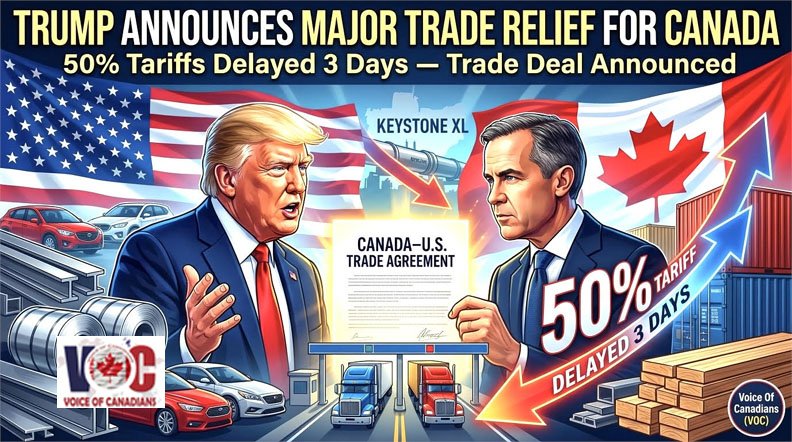
50% Tariffs Delayed for Three Days, Trade Deal Announced But Final Documents Still Pending
Negotiations Continue on Autos, Steel, Aluminum and Lumber Trump Also Signals Potential Keystone XL Development as Canada and U.S. Race Toward a Last-Minute Deal
Report: Mehboob Ali Shaikh
A major breakthrough has suddenly emerged amid escalating trade tensions between Canada and the United States. U.S. President Donald Trump has delayed the new 50% tariffs on Canadian products, which were scheduled to take effect on August 19, for three days, claiming that Washington and Ottawa have reached a trade agreement.
However, President Trump has made the development conditional on the completion of final documentation. Therefore, at this stage, it would be more accurate to describe the development as a major step toward a preliminary or framework agreement rather than a fully finalized trade deal.
President Trump announced on Truth Social Tuesday night that the 50% tariffs scheduled to take effect against Canada Wednesday morning would be delayed for three days.
According to Trump, the two countries have reached an agreement, although the final form of the deal will only become clear once the necessary documents are completed.
The announcement came after a full day of highly sensitive trade negotiations between Washington and Ottawa, with the outcome still uncertain only hours earlier.
Prime Minister Mark Carney and President Donald Trump spoke by telephone again on Tuesday. The Prime Minister’s Office confirmed at the time that the two leaders discussed the ongoing trade negotiations.
This was the second direct conversation between the two leaders that week, indicating that the trade dispute had reached the highest levels of political leadership
The proposed U.S. measures could have affected approximately US$20 billion worth of Canadian exports.
One major concern was that the new tariffs could have applied to certain products that normally receive preferential treatment under the CUSMA/USMCA trade framework.
Potentially affected sectors included cement, food and agricultural products, alcohol, lumber and hockey-related goods, among numerous other products.
U.S. tariffs on vehicles manufactured in Canada remained one of the biggest points of disagreement in the negotiations.
According to reports, the two countries were discussing the possibility of reducing the existing 25% Section 232 tariff on Canadian vehicles to 15%.
However, the key disagreement involved how the tariff exemption or reduction would be calculated.
Washington wanted the calculation to be based on the value of U.S.-made components used in the vehicles, while Canada argued that all North American content — including parts from Canada, the United States and Mexico — should be included.
This is not merely a technical disagreement. It is a critical issue for the North American auto industry, which represents billions of dollars in economic activity.
President Trump also made an unusual reference to the Keystone XL Pipeline in his announcement.
The presidential permit for the original Keystone XL project was revoked by former U.S. President Joe Biden in 2021.
However, in April 2026, President Trump had already granted a cross-border permit for a new Bridger/South Bow project that could increase the capacity to transport Canadian oil to the United States while utilizing portions of infrastructure associated with the former Keystone XL route.
Therefore, it is not yet clear whether Trump’s latest comments refer to restoring the original Keystone XL project in its previous form or to incorporating elements of it into a broader energy agreement.
The exact legal and practical meaning of the announcement will only become clear once the final trade documents are released.
Trade experts and business groups have repeatedly warned that broad tariffs would not only hurt Canadian businesses but could also increase costs for American consumers, farmers and manufacturers.
The agricultural, energy, automotive and manufacturing supply chains of Canada and the United States are deeply interconnected.
As a result, a trade barrier imposed on one side of the border can often have economic consequences on the other side as well.
Canadian industries are already dealing with the impact of various U.S. tariffs and trade restrictions.
The automotive, steel, aluminum, lumber and certain agricultural sectors could have faced significantly greater pressure under the proposed new 50% tariffs.
That is why the three-day tariff delay is not merely a diplomatic development. It carries immediate economic significance for thousands of businesses, workers, investors and consumers.
The biggest focus now is on what concessions Canada may have offered the United States under the potential agreement and, in return, which U.S. tariffs Washington may agree to reduce or eliminate.
Washington has long raised concerns over Canada’s dairy supply-management system, provincial market access for U.S. alcohol, certain Canadian retaliatory tariffs and market access for American products.
At the same time, Canada has been seeking significant reductions in U.S. tariffs affecting steel, aluminum, automobiles and other sectors.
President Trump has announced that an agreement has been reached, but he has also explicitly made the announcement conditional on the completion of final documentation.
As of the publication of this report, the Canadian government had not publicly released the complete agreement, its specific provisions, potential concessions, final tariff rates or any comprehensive package involving Keystone.
Therefore, the three-day tariff delay is a confirmed and significant development, but the final nature of a Canada–U.S. trade agreement will only become clear once the official documents are released.
Major Questions Still Remain
All eyes are now on the answers to several key questions:
Will the 50% tariffs be completely eliminated or merely reduced?
Will U.S. tariffs on Canadian vehicles fall from 25% to 15%?
Will Canada receive major relief on steel, aluminum and lumber?
What changes will Canada accept regarding U.S. dairy, alcohol and other products?
And what exactly is Trump’s Keystone XL announcement — and how does it fit into a broader energy package?
The three-day delay has temporarily prevented an immediate major trade confrontation, but negotiations are not over.
If the two countries reach agreement on the key sectors in the final documents, this development could mark the beginning of a new chapter in Canada–U.S. trade relations.
But if the two sides fail to agree on the final terms, the three-day delay could prove to be nothing more than a temporary ceasefire.
The real test now is not the announcement it is the final agreement.