Historic Changes to OSAP Take Effect: Will Higher Education Now Be Possible Only Through Loans?
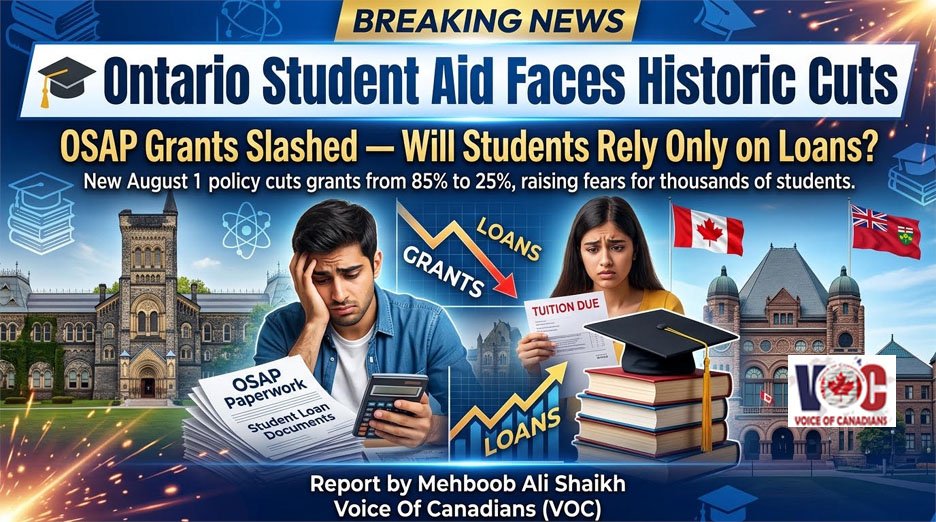
New policy effective August 1 reduces non-repayable grants from as much as 85% to a maximum of 25%; student organizations warn that thousands of young people could be forced to abandon their education.
Special Report by Mehboob Ali Shaikh
As of August 1, 2026, sweeping and controversial changes to Ontario’s Ontario Student Assistance Program (OSAP) have officially taken effect, leaving thousands of current and prospective students deeply concerned about their financial future.
Under the new policy, non-repayable provincial grants will account for no more than 25% of financial assistance, while at least 75% will be provided as repayable student loans.
The reforms represent far more than an administrative adjustment—they mark one of the most significant transformations in Ontario’s student financial aid system in years, raising serious questions about the future affordability of higher education.
Student organizations argue that, amid rising inflation, soaring rents, increasing food prices, transportation costs, and other living expenses, the government’s decision will make college and university education significantly less accessible for low- and middle-income families.
At the same time, the Ontario government has ended the domestic tuition freeze that had been in place at publicly funded colleges and universities for nearly seven years. Institutions will now be permitted to increase tuition fees by up to 2% annually for the next three years, adding further financial pressure on students.
Previously, eligible students could receive provincial assistance in which non-repayable grants covered as much as 85% of their OSAP funding. Under the new framework, however, grants have been capped at a maximum of 25%, with the remaining assistance largely provided in the form of loans that must be repaid after graduation.
Student leaders warn that the changes will not only increase financial stress during students’ academic years but could also burden graduates with years of debt, affecting their ability to purchase homes, start families, achieve financial stability, and build long-term economic security.
One of the students affected is Selena Marsolais, a Social Service Worker student at Cambrian College, who says the new policy has left her uncertain about whether she can complete her education.
Living with Post-Traumatic Stress Disorder (PTSD), Marsolais says she received approximately $8,000 in non-repayable grants last academic year. Under the new calculations, however, her grant could fall to around $1,000, with the remainder converted into repayable loans.
She says she now faces two difficult choices: take on even more debt to complete her final semester or leave school and find work simply to repay the debt she already owes.
Student organizations, including the Ontario Undergraduate Student Alliance (OUSA) and the College Student Alliance (CSA), argue that the changes will affect not only low-income students but also many middle-income families who are already struggling with the rising cost of living.
According to a preliminary survey of 680 students:
- Approximately 65% identified OSAP as their primary source of financial support.
- Nearly half expressed serious concern about carrying increased debt after graduation.
The organizations are urging the provincial government to:
- Make Ontario student loans interest-free.
- Extend the current six-month loan repayment grace period to at least two years, allowing graduates sufficient time to secure stable employment before repayment begins.
The Ontario government maintains that the previous OSAP model was financially unsustainable, citing increased demand for student assistance and changes to federal grant eligibility as key reasons for the reforms.
The province has also announced a $6.4 billion investment in post-secondary education over four years, including enhanced institutional funding, additional spaces in high-demand programs, and expanded support across the sector.
According to the government, the strengthened Student Access Guarantee will ensure that eligible low-income students continue to receive assistance covering tuition, mandatory fees, and textbooks. Colleges and universities will also be able to provide additional support through bursaries, scholarships, work-study opportunities, and other financial aid programs when necessary.
Education experts note that while increased institutional funding is important, it does not necessarily compensate for reductions in direct, non-repayable assistance to individual students. If grants are reduced and students are required to borrow more, equitable access to higher education could be significantly affected.
The true impact of the policy introduced on August 1, 2026, will become evident in the years ahead. The real test will be whether thousands of low- and middle-income students can continue pursuing higher education—or whether growing debt will force many to put their academic dreams on hold.