President Donald Trump’s new tariffs have put billions of dollars in trade at risk.
 The world is watching as Donald Trump and Mark Carney prepare for high-stakes trade talks.
 Is North America on the brink of a new trade war?
Report: Mehboob Ali Shaikh
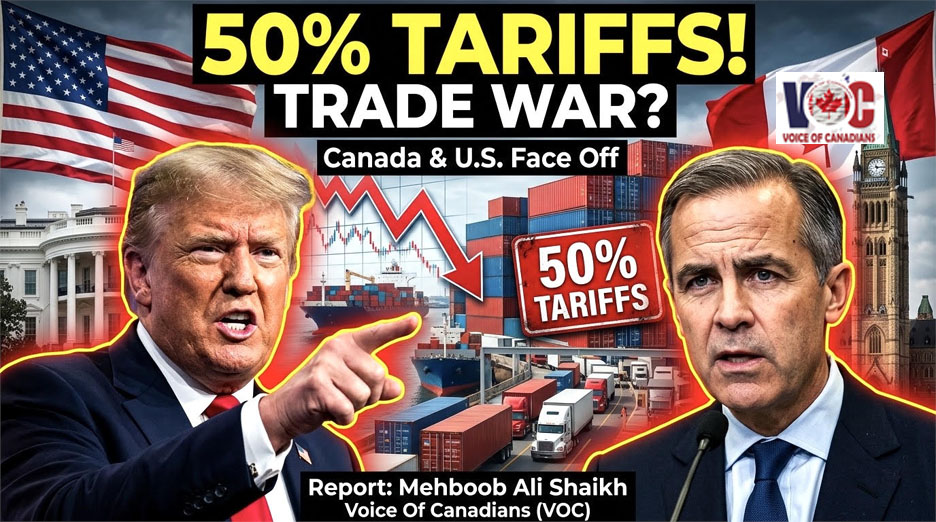
The United States has announced that it will impose new 50% tariffs on a wide range of Canadian products within the next month. U.S. President Donald Trump also stated that “Canada cannot survive without us.”
Responding firmly, Canadian Prime Minister Mark Carney said the move violates the Canada–United States–Mexico Agreement (CUSMA). He emphasized that Canada will continue negotiations while strengthening its economy and protecting its national interests.
Meanwhile, several Canadian provinces have pledged to remain united in responding to the U.S. measures. Economic experts estimate that the proposed tariffs could affect approximately CAD 28 billion worth of Canadian exports, with the greatest impact expected to fall on specific industries.
Trade tensions between the United States and Canada have once again intensified. President Donald Trump announced that the United States will introduce 50% tariffs on numerous Canadian products within the next month. The decision comes despite the CUSMA free trade agreement, raising new concerns about the future of North American trade relations.
Speaking to reporters at the White House, President Trump said:
“I like Canada and the Canadian people, but the reality is they need us to survive. Without us, they cannot.”
When asked whether smoke from the ongoing Canadian wildfires had influenced the decision, Trump replied that the matter was being considered separately.
Speaking to reporters in Ottawa, Prime Minister Mark Carney revealed that he had spoken with President Trump by telephone on Tuesday morning. Both leaders agreed to accelerate negotiations over the coming weeks.
However, Carney stressed that the new U.S. tariff package is a clear violation of the CUSMA agreement. He said Canada would remain focused on strengthening its domestic economy, encouraging Canadians to buy Canadian-made products, and expanding economic partnerships with countries around the world.
British Columbia Premier David Eby took a strong stance, declaring:
“There is no chance in hell that American liquor will return to British Columbia store shelves.”
It is worth noting that, with the exception of Alberta and Saskatchewan, most Canadian provinces have suspended the sale of U.S. alcoholic beverages as a retaliatory response to previous American tariffs.
Eby added that he felt sorry for the American people, saying that losing a friend like Canada would leave the United States increasingly isolated, making it more difficult to find genuine partners around the world.
According to the tariff list released by the White House, the new duties will apply to a wide range of Canadian products, including:
- Honey
- Hockey sticks
- Plywood
- Various wood products
- Cement
- Clothing
- Golf equipment
- Ice skates
- Video game consoles
- Toilet paper
- Various alcoholic beverages
- Milk and dairy products
- Selected vehicles and automotive-related products
Economic analysts estimate that the tariffs could affect approximately CAD 28 billion in annual Canadian exports. While Canada’s overall economy is expected to withstand the pressure, industries such as forestry, food processing, and manufacturing could face significant challenges.
Ontario Premier Doug Ford stated that all Canadian provinces remain united and will not bow to external pressure.
Meanwhile, Toronto Mayor Olivia Chow announced that the city’s Economic Action Team has been reactivated to develop strategies to address the potential economic impact of the trade dispute.
According to a recent public opinion survey, only 35% of Canadians now consider the United States a reliable trading partner, compared with 83% in 2022. Analysts say the figures reflect the growing level of distrust in the economic relationship between the two neighbouring countries.