Following recent military strikes by the United States and Israel on Iran, concerns have emerged that Tehran may attempt to disrupt global oil shipments by blocking the strategically vital Strait of Hormuz. The narrow waterway is considered the most important route for international oil transport, and there are fears Iran could deploy sea mines to interfere with tanker traffic.
During the ongoing conflict in the Middle East, Donald Trump stated that American forces had targeted and destroyed 28 Iranian vessels believed to be capable of laying naval mines.
What are sea mines?
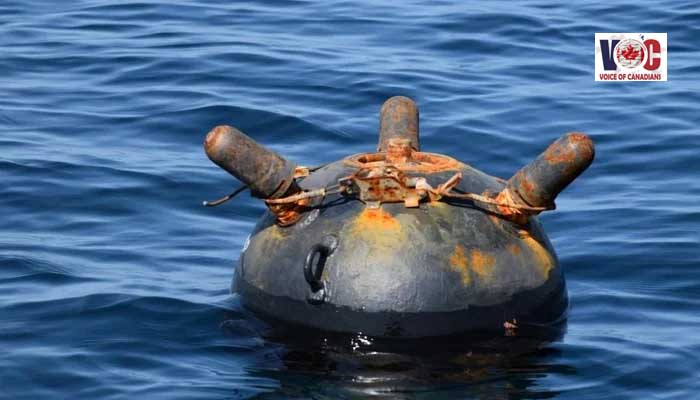
Naval mines are explosive devices placed in water to damage or sink ships. Despite being relatively inexpensive compared to other weapons, they can significantly threaten maritime trade and naval operations by restricting the safe movement of vessels.
Iran’s mine capabilities
Iran is believed to possess thousands of naval mines, with estimates suggesting between 5,000 and 6,000 units. These include different types of mines designed for various conditions in the Persian Gulf.
Contact mines are among the simplest varieties. They can either float with ocean currents or remain attached to anchors on the seabed. When a ship’s hull touches the mine, it detonates.
Another category is influence mines, which lie on the seabed and explode when sensors detect the presence of a large vessel passing above them. These are particularly effective in the relatively shallow waters of the Gulf.
Iran could also deploy limpet mines, which are small explosives that can be attached directly to ships by divers or fast boats. These devices can be timed to explode later.
Small, high-speed boats are capable of rapidly laying mines across areas such as the Strait of Hormuz, allowing Iran to deploy them quickly and discreetly.
Historical use of naval mines
Naval mines have been used in the region before. During the Tanker War in the 1980s, Iran placed mines in shipping lanes, which prompted the United States to escort commercial vessels traveling through the Gulf.
Later, during the Gulf War, Iraqi forces deployed more than 1,300 mines, damaging two US Navy ships, including the USS Princeton (CG-59). Repairing the vessel reportedly cost around $100 million.
Clearing the mines in the northern Gulf after the war required more than two years of extensive operations by coalition forces.
Challenges of clearing mines
If mines were deployed in the Strait of Hormuz, removing them would be a difficult and time-consuming task. Western navies have the technology and expertise to conduct mine-clearing operations, but such missions can be complex and slow.
Mine-hunting ships, drones, and divers are usually used to locate and neutralise underwater explosives. However, detecting mines in a busy and strategically important waterway can be extremely challenging.
Several countries have reduced their dedicated mine-hunting fleets in recent years. Some European nations still maintain specialised vessels and are developing advanced systems that use underwater drones to identify and safely disable mines.
Gulf countries also maintain trained diving teams capable of assisting in mine-removal efforts. However, the first and most difficult step in clearing mines is locating them within large areas of open water.