
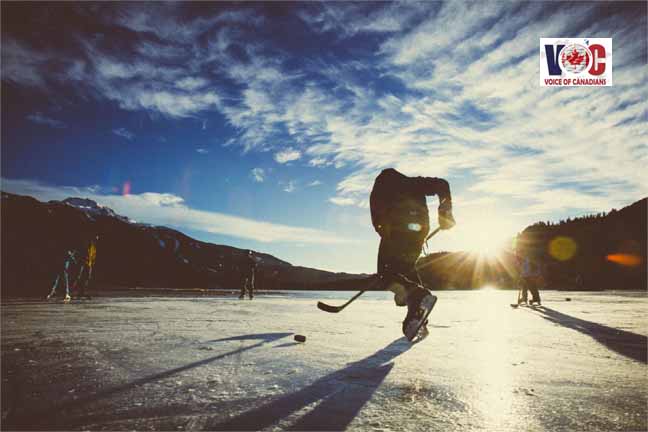
From backyard rinks to Olympic arenas, hockey is more than a sport for Canadians — it’s a symbol of national identity.
This spring, students can gain a deeper understanding of Canadian sport and its lasting influence on society in CANA 2P11 Elbows Up?: Sports and Canadian Culture.
Associate Professor of Film Studies Anthony Kinik, who also serves as Director of Canadian Studies, says the new course connects Canadian culture and sports history from the 19th century to the present.
As “Canada’s game,” requisite attention will be given to hockey, Kinik says, but the course will also cover other major Canadian sports, including curling, basketball, baseball, rugby and parasports.
“This survey of Canadian sports culture intersects with a range of other issues encompassing gender, race, class and ethnicity. This will be a rich, challenging and rewarding course,” he says. “We’re confident that it will strike a chord with students and help bring about a greater appreciation of Canada and Canadian Studies.”
The cyclical relationship between political issues and sports and sports figures is a key concept of the course according to Professor of Kinesiology Maureen Connolly, who will be instructing CANA 2P11.
“I hope that students come to appreciate how sports and sports figures embody larger themes of any given historical period,” she says.
Students will explore Canadian hockey icon Ken Dryden’s on-ice accomplishments and off-ice leadership, for example, to learn more about how high level athletes can be influential across contexts.
Throughout the course, Connolly will draw on a blend of scholarly materials from history and sociology of sport as well as various media including print newspapers, social media, biographies and autobiographies, interviews and popular publications all relating to different iconic sports figures and events.
“The course will be inclusive of different kinds of sporting bodies and will expose students to a broad range of sports-based athletes, coaches and builders,” she says.
Connolly will also present students with what she refers to as “disorienting dilemmas” and “celebratory narratives”.
An example of a disorienting dilemma, Connolly explains, would be an experience that compels people to question assumptions.
“For example, hockey may indeed be a site of national pride and unity, but it is also a site of toxic masculinity where unhealthy behaviours are often supported and reproduced,” she says.
Celebratory narratives are stories of victories or milestone moments that have the potential to bring people together in unifying ways, like the Toronto Blue Jays two world series wins in the 1990’s, the Toronto Raptors “We the North” championship and the ongoing commemoration of Terry Fox’s run.
“Both celebratory narratives and disorienting dilemmas are contexts to explore the complex relationships between sport achievement and Canadian culture and identity,” Connolly says.
For more information on Brock’s Spring/Summer courses or to register visit brocku.ca/springsummer