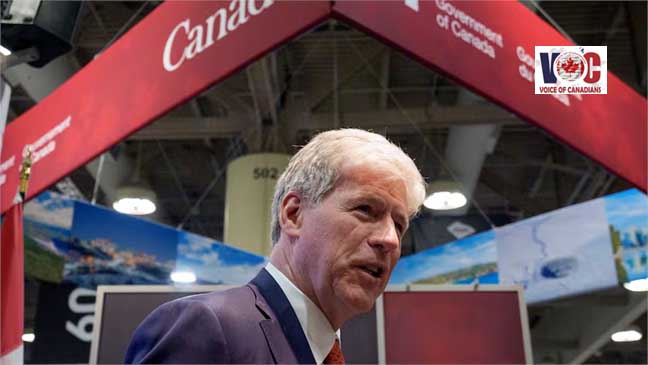
Energy and Natural Resources Minister Tim Hodgson says a surge in global instability triggered by the conflict in Iran has prompted fresh international interest in Canadian energy exports, as oil and gas prices climb sharply.
In an interview with CBC News, Hodgson said several countries have begun inquiring about Canada’s capacity to expand both conventional and clean energy supplies.
“The world right now is feeling incredibly insecure as a result of this weekend,” he said, pointing to the geopolitical shockwaves from the Middle East. “We’ve already seen an uptick in inquiries about how quickly Canada can expand its clean and conventional energy exports.”
While declining to identify the governments making contact, Hodgson cautioned that increasing production cannot happen overnight. Scaling up liquefied natural gas (LNG) or oil output, he noted, requires time and significant operational adjustments.
The minister made the remarks on the sidelines of a major mining conference in Toronto, where he argued that heightened geopolitical risk and potential supply disruptions reinforce the case for Canada to further develop its natural resources sector.
Critical minerals as strategic leverage
In a keynote address at the Prospectors & Developers Association of Canada conference, Hodgson shifted focus to critical minerals, describing them as central to both Canada’s sovereignty and the security of allied nations.
He said Ottawa views its reserves of key minerals and metals — essential for advanced electronics, electric vehicles and defence systems — as strategic assets in ongoing trade discussions. Without explicitly naming the United States, Hodgson alluded to Washington’s assertive trade posture as “the obvious elephant in the room,” while also highlighting concerns over China’s dominance in global mineral supply chains.
“For Canada and our allies, overreliance on concentrated foreign supply chains creates vulnerability,” he said, adding that Canada offers a stable and reliable alternative. “And Canada will never use our resources as a coercive tool.”
Billions pledged for mining expansion
Hodgson announced $3.6 billion in new investments aimed at expanding domestic mining and processing capacity for critical minerals. The package includes up to $165 million earmarked to accelerate planning and development across 22 projects nationwide.
Following the recent federal budget, the government also launched a $1.5-billion First and Last Mile Fund to support infrastructure needed to move minerals from extraction sites to processing facilities.
In addition, Ottawa plans to introduce a $2-billion Critical Minerals Sovereign Fund this spring. The government describes it as the first vehicle of its kind in Canada, enabling equity investments, loan guarantees and offtake agreements with mining companies. Such agreements would allow the government to purchase predetermined quantities of output, ensuring stable demand and reducing financial risk for new projects.
Hodgson said 30 new partnerships and investment agreements — spanning 10 allied countries, the European Union and the United Nations — are expected to unlock $12.1 billion in mining capital. The initiatives form part of the government’s critical minerals production alliance, launched during Canada’s G7 presidency. The alliance effectively establishes a buyers’ network among G7 nations, including the United States, the United Kingdom, Germany, Japan, France, Italy and Canada.
“A mining and minerals powerhouse”
Framing the sector as pivotal to Canada’s future, Hodgson described the country as a “mining and minerals powerhouse” whose resources sit at the intersection of economic security, sovereignty and global influence.
He argued that critical minerals underpin defence technologies, advanced computing, telecommunications and clean energy systems, while expanded mining in the North strengthens Canada’s Arctic sovereignty and long-term strategic presence.
Last October, the federal government designated certain critical minerals as a national security priority under the Defence Production Act, enabling Ottawa to provide stronger financial backing to the sector, including price guarantees and assured government purchases.
Against a backdrop of global supply uncertainty and intensifying geopolitical competition, Hodgson’s message was clear: Canada intends not only to extract its natural wealth, but to leverage it strategically in an increasingly volatile world.