
Global air travel remained heavily disrupted on Sunday as war in Iran kept major Middle Eastern airports including Dubai, the world’s busiest international hub, closed for a second day in one of the sharpest aviation shocks in recent years.
Key transit airports, including Dubai and Abu Dhabi in the UAE and Doha in Qatar, were shut or severely restricted as much of the region’s airspace remained closed after U.S. and Israeli strikes killed Iranian Supreme Leader Ayatollah Ali Khamenei.
Thousands of flights have been affected across the Middle East, according to data on flight-tracking platform FlightAware.
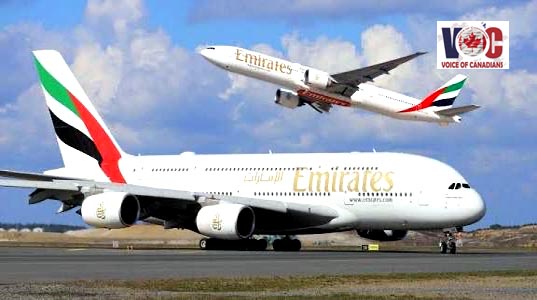
Emirates, the world’s largest international carrier, said it had suspended all operations to and from its Dubai megahub until Monday.
Qatar Airways, which has suspended all operations, said it would provide a further update on Monday and Germany’s Lufthansa (LHAG.DE), opens new tab extended its suspension of flights to the region to March 8.
Hundreds of thousands of stranded travelers have been left scrambling as the conflict spills over, shutting down much of the Middle East to air travel.
Around 3,000 flights have been cancelled since the conflict in Iran began Saturday and subsequent attacks by Iran continue to impact other parts of the region, according to aviation-data firm Cirium.
Airspace was closed over a large swath of the Middle East, suspending flights to and from Dubai International Airport, one of the busiest hubs in the world, Tel Aviv, and Doha, Qatar. More than 40 flights were forced to divert early Saturday morning after the attack prompted airspace closures in the region.
That means customers connecting through major hubs in the region are also affected, with vacationers, business travelers, and other flyers stranded around the world.
Air Canada has cancelled flights from Canada to Tel Aviv until March 8 and halted air travel to Dubai until Tuesday.
“If you are in either of these regions, please do not head to the airport,” the airline warns.
Canada’s largest flight hub, Toronto’s Pearson Airport, is warning of delays and cancellations due to widespread airspace closures and are advising passengers to check their flight status before coming to the airport.
The conflict has shut down airports and international airspace above Israel, Qatar, Syria, Iran, Iraq, Kuwait, Bahrain, Oman and the United Arab Emirates.
Officials at Dubai International Airport — the largest in the United Arab Emirates and one of the busiest in the world — said four people were injured, while Zayed International Airport in Abu Dhabi said that one person was killed and seven others were injured in a drone strike. Strikes were also reported at Kuwait International Airport.
Canada is warning people to avoid all travel to large swaths of the Middle East since the conflict began yesterday, including Lebanon, Israel and Palestine, Iraq, Qatar, Bahrain, United Arab Emirates, Kuwait, Iran, Syria and Yemen.
Canadians are warned to avoid non-essential travel to Oman, Saudi Arabia and Jordan.