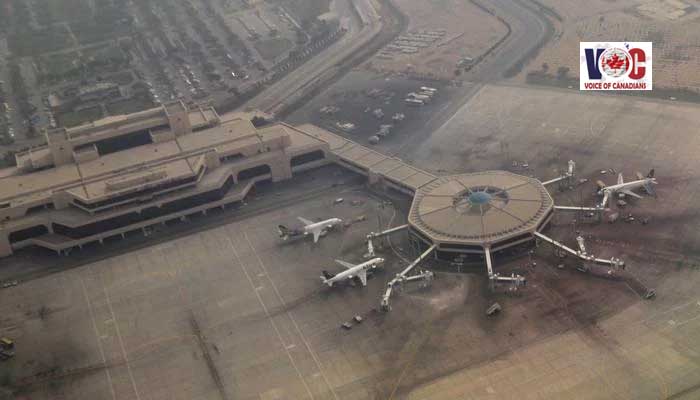
KARACHI: The Pakistan Airports Authority (PAA) on Tuesday firmly dismissed reports claiming that commercial flight operations had been curtailed, asserting that Pakistan’s airspace remains entirely open and secure for all categories of civil aviation traffic.
The clarification came in response to media reports suggesting a partial closure of Pakistani airspace amid security concerns arising from the escalating confrontation between the United States and Iran — a conflict that has disrupted aviation operations across parts of the Middle East and beyond.
In an official statement, the authority emphasised that Pakistan’s airspace “remains fully open, safe, and completely available for all civil aviation traffic, including commercial flights.” It further stated that air traffic services are continuing without interruption and that alternative routing options are available and routinely utilised where necessary.
The PAA made clear that no restrictions have been imposed on commercial arrivals, departures, or overflights anywhere within the country’s airspace. It added that air traffic controllers and airport personnel are functioning normally and are effectively managing flight operations.
Rejecting the interpretation circulating in sections of the media, the authority described reports regarding a Notice to Airmen (NOTAM) as “incorrect and misleading,” clarifying that the advisory in question was a routine operational measure. The specified routes, it explained, were temporarily closed from ground level to unlimited altitude for standard operational reasons.
The aviation regulator urged media outlets and social media users to rely exclusively on verified official statements and to refrain from speculative reporting that could create unwarranted anxiety among passengers and the general public.
The clarification comes at a time when global aviation networks have faced significant turbulence. Since Sunday, sustained air strikes in the Middle East have led to the closure of several major airports, including Dubai International Airport — widely regarded as the world’s busiest international transit hub — resulting in one of the most severe disruptions to air travel in recent years.
Key transit centres such as Abu Dhabi International Airport and Hamad International Airport have either suspended operations or imposed stringent restrictions, while extensive portions of regional airspace remain closed.
The upheaval followed coordinated US and Israeli strikes that reportedly resulted in the death of Iran’s Supreme Leader, Ali Khamenei, intensifying uncertainty and instability across the Gulf region.