
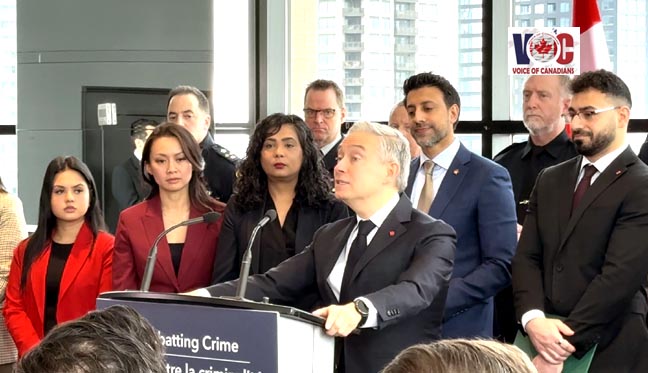
Canada (Report by Mehboob Ali Shaikh) Canada’s Federal Minister of Finance and National Revenue, François-Philippe Champagne, has delivered a blunt message to organized criminal groups terrorizing Canadian communities through extortion: enough is enough.
He warned those involved in extortion to be aware that individuals engaged in such crimes in Canada will face the strictest punishment. He emphasized that extortion is no longer merely an isolated street crime but has evolved into a sophisticated and organized enterprise that poses a threat to Canada’s economic integrity and social fabric.
Speaking yesterday at a press conference in Mississauga, Champagne was joined by Canada’s Minister of International Trade Maninder Sidhu; Minister for Women and Gender Equality and Secretary of State (Small Business and Tourism) Rechie Valdez; President of the Treasury Board Shafqat Ali; Members of Parliament Iqra Khalid, Fares Al Soud, Amandeep Sidhu, Peter Fonseca, and Sonia Sidhu; Mississauga Mayor Carolyn Parrish; Peel Regional Police Deputy Chief Nick Milinovich; and Sarah Paquet, Director and Chief Executive Officer of the Financial Transactions and Reports Analysis Centre.
He stated that for many Canadian individuals and businesses, extortion has become a daily reality. “That fear will now end,” he said, adding that a “Follow the Money” plan has been prepared to tackle the extortion crisis.
He noted that in light of rising extortion incidents in cities such as Brampton, Mississauga, and Surrey, the federal government has announced an unprecedented strategy aimed at dismantling criminal networks by targeting their financial lifelines.
At the core of the new federal plan is the mobilization of Canada’s national financial intelligence agency, the Financial Transactions and Reports Analysis Centre of Canada (FINTRAC). For the first time, FINTRAC will deploy dedicated liaison officers who will work directly with police in the most affected regions of Ontario, British Columbia, and Alberta.
Champagne said Canadians have the right to feel safe in their homes. “We are providing law enforcement agencies with new tools to fight crime,” he added.
Peel Regional Police Deputy Chief of Investigations and Emergency Services Nick Milinovich said data shows that approximately 490 extortion-related crimes were reported. Although there has been a slight decrease in overall incidents in 2025, nearly 200 businesses have already been targeted this year.
Responding to a question, he stated that in Brampton and Mississauga, extortion has become a daily reality for many business owners, particularly within the South Asian community. Criminals often demand large sums of money; if victims refuse, they face threats, vandalism, and in some cases, shootings at homes and businesses.
The Federal Minister’s further noted that authorities in Surrey have identified a troubling trend: foreign students are allegedly being recruited to carry out intimidation tactics on behalf of organized crime groups. Local police have released videos in multiple languages, including Punjabi, urging young people to stay away from such activities.
Federal Minister’s stated that the government has established a coordinated system involving federal agencies, provincial authorities, financial institutions, and municipal police forces to implement a broader strategy against extortionists and organized crime. This includes plans to establish a new Canada Financial Crimes Agency and increased investment to enhance the RCMP’s investigative capacity.
They explained that the strategy is based on what officials call a “Follow the Money” approach — tracing the flow of funds. By strengthening the collection and sharing of financial intelligence, authorities aim to identify the networks that finance and coordinate extortion schemes, many of which operate across borders and use digital platforms and cryptocurrency to conceal transactions.
Detailing new measures under FINTRAC, he said the agency will:
- Increase financial intelligence resources to combat extortion.
- Launch a “Countering Extortion Partnership” with banks, credit unions, cryptocurrency service providers, and regulators such as the Office of the Superintendent of Financial Institutions.
- Work closely with the Royal Canadian Mounted Police (RCMP) and local police services.
- Assign financial intelligence experts to support investigations.
- Issue a “Targeted Indicator Profile (TIP)” to help financial institutions quickly identify suspicious transactions.
- Publish strategic intelligence explaining how criminals launder proceeds obtained through extortion.
According to Deputy Chief Milinovich, residents say the sound of gunfire has become alarmingly common. Some victims, fearing retaliation or doubting the effectiveness of law enforcement, choose not to report incidents.
The federal government says these measures are part of a broader strategy to combat organized crime, including plans for the new Canada Financial Crimes Agency and additional investments to strengthen the RCMP’s investigative capacity.
It is worth noting that municipal leaders — including Brampton Mayor Patrick Brown and Surrey’s mayor — had called on the federal government last month for stronger intervention, describing the violence linked to extortion as a crisis threatening public safety and economic stability.
Now, the key question is whether the financial crackdown will provide immediate relief to affected communities. However, Ottawa’s message is clear: by cutting off the flow of money, the government is determined to dismantle the networks profiting from fear. Residents of Brampton, Mississauga, Surrey, and other areas hope this move will mark the beginning of safer nights and an end to the silence imposed by organized crime.