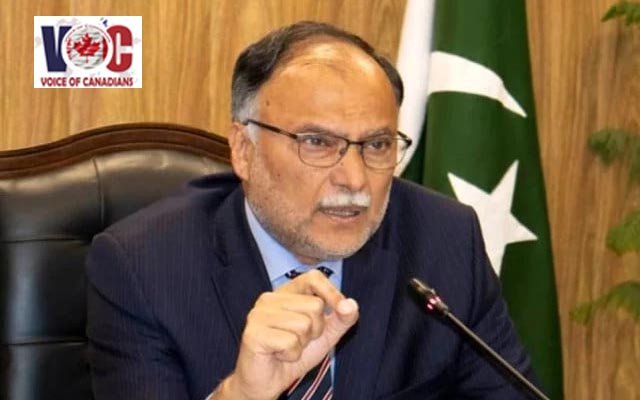
Planning Minister Ahsan Iqbal has sought Prime Minister Shehbaz Sharif’s intervention to include his ministry in parleys with the International Monetary Fund (IMF), saying that the $7 billion programme is not just about numbers but about people and economic development.
His remarks came as Jamaat-e-Islami began a march towards Islamabad, demanding relief from double-digit inflation. While addressing a press conference, the minister also urged Jamaat-e-Islami, farmers, Pakistan Tehreek-e-Insaf (PTI) and the defunct Awami Action Committee to cancel their rally towards Islamabad and said that the consequent political instability would serve India’s agenda.
“I have recommended to the prime minister that a representative of the Planning Commission should also be included in the team that will negotiate with the IMF,” said Iqbal while responding to a question.
Pakistan-IMF talks for the fourth review of the $7 billion programme will begin on Wednesday and continue through October 7. A successful completion of the review will lead to the release of the fifth loan tranche of $1 billion under the Extended Fund Facility and another $210 million under the climate support facility.
The planning minister said that the IMF programme was not just about numbers but it would have implications for economic growth, development and people. The statement underscores the strong role of the finance ministry in the IMF programme, which has resulted in criticism from government circles and independent experts about viewing the financing facility only in relation to fiscal numbers.
The finance ministry has kept a tight control over the programme design and negotiations, which caused problems such as commitments about the agriculture sector and focusing too much on fiscal stabilisation.
The finance ministry has made petroleum levy the central point of the programme, although there is no explicit condition in the IMF document about the rate of the levy. As a result, the government has managed to improve fiscal numbers but it fueled inflation, unemployment, poverty and low economic growth.
To a question about when the prolonged economic stabilisation would end, the planning minister said that it would depend on both the positive sentiment and domestic economic structure. The government is in the fifth year of economic stabilisation, which has caused immense pain to the common man.