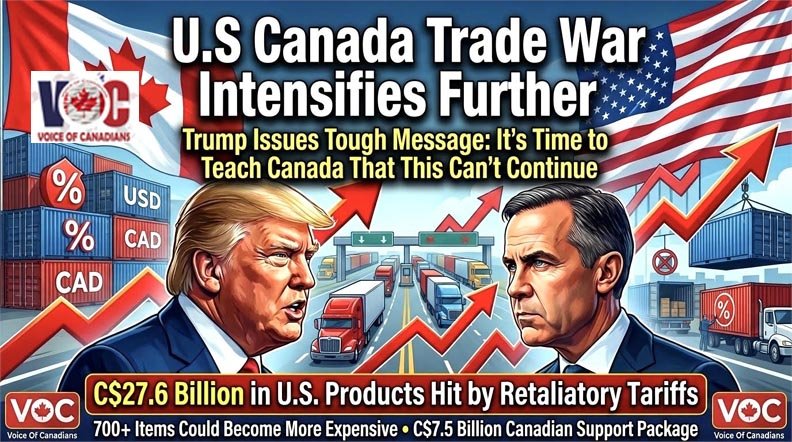
Trump’s Tough Message: It’s Time to Teach Canada That This Can’t Continue, While Canada Shows No Signs of Backing Down
Retaliatory Tariffs on C$27.6 Billion Worth of U.S. Products; More Than 700 Items Could Become More Expensive Starting September 8; Canada Also Announces a C$7.5 Billion Support Package
Report: Mehboob Ali Shaikh
The close trade partnership between the United States and Canada, built over several decades, is once again facing a serious crisis. Following strong statements from U.S. President Donald Trump and new U.S. tariffs, Canada has also announced a strong retaliatory response, raising concerns that the trade war in North America could escalate further.
The U.S.–Canada trade war has intensified further. U.S. President Donald Trump has said that it is now “time to teach Canada that this can’t continue,” while Ottawa has announced dollar-for-dollar retaliatory tariffs of 15 to 50 percent on more than 700 U.S. products worth C$27.6 billion, effective September 8.
Canada has also introduced a C$7.5 billion support package for affected workers and businesses. The biggest question now is whether the two countries will return to the negotiating table before September 8, or whether two of the world’s closest trading partners will enter a longer and more costly economic conflict.
According to the Canadian government, intense negotiations were held with the United States toward a comprehensive trade agreement, but the latest conditions proposed by the U.S. side were not acceptable to Canada.
Federal Finance Minister François-Philippe Champagne said the United States was asking too much from Canada while offering too little in return. The government’s position is that the proposed conditions could have harmed Canadian workers, businesses, and key industries.
For this reason, Canada chose not to accept an unfavourable agreement and instead suspended negotiations and moved toward retaliatory trade measures.
A new and extraordinary level of tension has emerged in the world’s largest and deepest bilateral trading relationship between the United States and Canada. On Wednesday, August 26, U.S. President Donald Trump told radio host Glenn Beck in an interview that it was now time to tell Canada that it “can’t do this anymore.”
Trump argued that the United States could obtain most of the goods it needs from countries other than Canada and that, without Canada, the U.S. economy would face, at most, some temporary “inconvenience.”
The latest phase began when Washington imposed new tariffs of up to 50 percent on approximately C$27.6 billion worth of Canadian goods starting August 22. In U.S. dollars, the amount is approximately US$20 billion.
According to Canada’s Department of Finance, Ottawa and Washington had been negotiating a comprehensive trade agreement for several months. However, after new conditions emerged from the U.S. side at the final stage, Canada suspended the negotiations, considering the proposed agreement unsuitable for the country’s economic interests and sovereignty.
Canada has made it clear that its response to U.S. tariffs will not be limited to political statements. The federal government has announced that, beginning September 8, 2026, retaliatory tariffs of 15, 25 and 50 percent will be imposed on U.S. imports worth C$27.6 billion.
The official list includes more than 700 U.S. products, with the applicable tariff rate for each item corresponding to the U.S. tariff imposed on Canadian products of the same type.
According to the list released by the Canadian government, the new tariffs cover a wide range of sectors, including steel, aluminum, dairy products, household electrical appliances, agricultural machinery, pulp and paper, and electronics.
Some products will face tariffs of 50 percent, others 25 percent, while selected items will be subject to 15 percent tariffs. This means that if importers do not absorb the additional costs themselves, some of those costs could ultimately be passed on to Canadian consumers through higher prices.
The federal government has also announced a C$7.5 billion support package for Canadian businesses and workers. To reduce the potential economic impact of the trade war, Ottawa has introduced new and expanded measures worth C$7.5 billion. According to the government, the funding will particularly support affected workers, small and medium-sized businesses, and export-oriented sectors.
The measures include business loans and liquidity support, the Canada Strong Diversification Fund to help diversify export markets, and billions of dollars through Rapid Response programs for workers and employers. The government says this package is in addition to approximately C$25 billion in tariff support already provided.
On August 25, the White House issued a strongly worded statement titled “President Trump Is Finally Ending Canada’s Free Ride,” claiming that Canada has maintained unfair trade barriers against U.S. businesses and products for decades.
The U.S. administration also cited alcohol, dairy, aviation, and several other sectors, claiming that Washington had offered Canada special market access and concessions in areas including steel, aluminum, automobiles, and lumber, but that Ottawa had not accepted them. This is the White House’s position, which the Canadian government disputes.
This has become one of the most contentious questions in the current dispute. U.S. officials had previously argued that Canada backed away from commitments and imposed new conditions during the final stage of negotiations.
Prime Minister Mark Carney, on the other hand, has said that new and “unfair” proposals were introduced by the United States at the last moment, particularly concerning the automotive sector and Canada’s freedom to pursue future trade agreements with third countries.
More importantly, when Trump was asked in a CNN interview whether the United States had added new conditions at the last minute, he did not rule out that possibility. The issue has now made the question of what actually changed at the negotiating table in the final stage even more significant.
The Canadian and U.S. auto sectors operate less like traditional import-and-export industries and more like a shared North American supply chain. A vehicle’s parts can cross the border several times before the vehicle is fully assembled.
That is why heavy tariffs could increase costs not only for Canadian factories but also for assembly plants in Michigan and other U.S. states. Reuters has also reported that tariffs on Canadian auto parts, steel, and other products could affect production costs and supply chains in both countries.
Impact on the Average Consumer
The effects could also become visible for ordinary consumers. Retaliatory tariffs are intended to create political and economic pressure, but import duties are actually paid by the importer. If businesses do not absorb the additional cost through their own profits, some of it can eventually be passed on to consumers.
That is why Canada faces a double challenge: applying enough pressure on the United States to bring negotiations back to the table while avoiding tariffs on U.S. products whose higher prices could cause greater harm to Canadian families or industries.
The fundamental question is where the Canada–U.S. economic partnership, one of the world’s most integrated trading relationships, is heading.
If trade tensions continue for an extended period, uncertainty could increase for companies making decisions about investment, supply chains, hiring, and production. At the same time, Canada’s strategy of reducing dependence on U.S. imports, encouraging domestic production, and diversifying trade toward other global markets could accelerate.
That is why initiatives such as the Canada Strong Diversification Fund represent not only immediate assistance but also a signal of Canada’s longer-term economic direction.
The most important question in the coming days will be whether Washington and Ottawa return to the negotiating table or whether trade tensions in North America escalate further.
Canada has announced retaliatory tariffs of 15, 25 and 50 percent on U.S. imports worth C$27.6 billion in response to new U.S. tariffs on Canadian products of the same value. The new measures will take effect on September 8 and will affect electronics, steel, dairy products, household appliances, furniture, clothing, and numerous other products.
At the same time, the federal government has introduced a C$7.5 billion support package for Canadian workers and businesses affected by the trade war, including temporary EI measures, business liquidity support, retraining, and billions of dollars for diversification. Attention is now focused on September 8 and on whether the United States and Canada will return to the negotiating table or whether the trade front will become even more heated.
The free trade agreement between Canada, the United States, and Mexico, CUSMA/USMCA, has long been the foundation of North American trade. The current tariff dispute is raising serious questions about the agreement’s practical future and its upcoming review.
Some trade experts believe that if large-scale unilateral and retaliatory tariffs remain in place for an extended period, they could undermine the fundamental concept of free trade. However, it would be premature at this stage to say that CUSMA has legally “ended.”
Politically, Prime Minister Mark Carney is receiving support from several provincial leaders in confronting U.S. pressure, although there is no complete consensus on how far Canada should go.
Ontario Premier Doug Ford has supported stronger measures and direct pressure on the U.S. economy, while some other leaders have urged caution about using essential exports such as energy or electricity as trade weapons.
This disagreement raises an important question: How far can Canada go in imposing economic costs on the United States without causing a larger share of that damage to be absorbed by the Canadian economy itself?
Poilievre’s Question: Canadians Deserve to Know the Real Cost of Retaliatory Tariffs
The federal Conservative leadership has broadly described the U.S. 50 percent tariffs as unjustified and has called on the government to respond firmly. At the same time, pressure is growing on Prime Minister Mark Carney to disclose the details of the rejected U.S. agreement and explain the potential cost of Canadian retaliatory tariffs to consumers.
This political debate will be important in the coming weeks, as affordability, alongside national unity, could become a major political test for the Canadian government.
It would also be incorrect to assume that there is complete agreement within the United States over this trade strategy. Concern is growing among border states, small businesses, and industries that directly depend on Canadian raw materials, consumers, or supply chains.
California Governor Gavin Newsom has predicted that growing domestic political and economic pressure could eventually force Trump to change his position on the latest tariffs against Canada. However, at present, this remains Newsom’s political prediction, not established U.S. policy.
The human dimension of this trade war may be the most important of all. Canadian exporters face the risk of losing access to the U.S. market, while U.S. businesses could face shortages or higher costs for Canadian raw materials and lose access to Canadian consumers.
For small businesses in particular, the biggest challenge is not simply the current tariffs but the uncertainty over how they can plan prices, investments, and employment for the next six months or year when trade policies can change within days.
The current crisis is also highlighting a long-term weakness for Canada: its unusually heavy dependence on the U.S. market.
Some Canadian businesses are already looking for new buyers in Asia, Europe, and other regions. This shift cannot immediately replace the United States, but if the current dispute continues for an extended period, Canada’s trade strategy could fundamentally move toward a more diversified global market.
This issue is no longer limited to imposing 25 or 50 percent duties on selected products. The real question is the future of the North American economic system.
For decades, Canada and the United States built their industries on the assumption that the border was not a barrier to trade but part of an integrated supply chain. If both countries begin using each other’s products as economic weapons on a permanent basis, businesses may begin restructuring their factories, suppliers, investments, and markets.
Reversing such a transformation would not be easy, even with a new trade agreement.
September 8 is the day Canada’s latest retaliatory tariffs are scheduled to take effect. The period before then provides both governments with a potential diplomatic “off-ramp.”
If negotiations resume during this period and an acceptable agreement is reached, tensions could ease. If not, more than 700 U.S. products will enter the new tariff regime, and the impact of the trade war will begin reaching markets, industries, jobs, and consumers more directly.