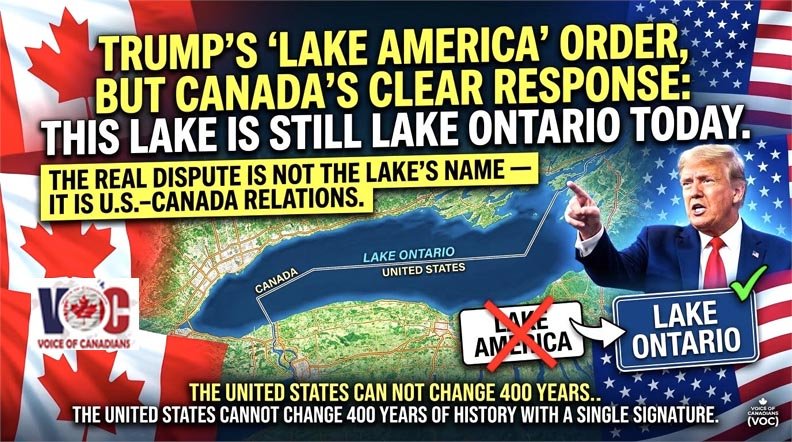
A country’s official name does not automatically become binding on another country. The real dispute is not the name of the lake—it is about U.S.–Canada relations. America cannot change 400 years of history with a single signature.
Report: Mehboob Ali Shaikh
U.S. President Donald Trump signed an Executive Order on August 27, 2026, directing U.S. federal agencies to use the name “Lake America” for Lake Ontario. However, this is a decision within the U.S. federal naming system; Canada is not obligated to adopt the name. Canadian Prime Minister Mark Carney has made it clear that the more-than-400-year-old name Lake Ontario will remain.
The identity of Lake Ontario is connected to Indigenous linguistic history, and the name appears in written records from before both the U.S. Declaration of Independence and Canadian Confederation. Therefore, while the United States can change its official maps, a presidential signature cannot erase centuries of history, Indigenous heritage, or Canada’s own geographic identity.
The decision to change the name comes at a time when trade relations between Canada and the United States are under severe strain. Following the failure of recent negotiations, both countries have taken steps to impose or expand heavy tariffs on billions of dollars’ worth of each other’s products.
The United States announced 50 percent tariffs on approximately US$20 billion worth of Canadian products, while Canada responded with retaliatory tariffs on American products of roughly the same value.
Against this backdrop, the “Lake America” decision is being viewed not merely as a geographic name change, but also as a form of political pressure on Canada and a nationalist message from the United States.
In Executive Order 14420 issued by the White House, the Trump administration argued that the United States has made significant investments in protecting the Great Lakes, shipping, environmental protection, and icebreaking vessels.
The order also claims that the United States is the greatest protector of the Great Lakes, that the United States provides nine of the 11 icebreakers serving the Great Lakes, that America has spent approximately $4 billion over the past decade on environmental protection of the lakes, and that the deepest parts of the lake are located within U.S. territory. These are the Trump administration’s stated positions; they do not change Canada’s sovereignty, the existing border, or Canadian jurisdiction over the Canadian portion of the lake.
Lake Ontario is one of North America’s five Great Lakes. The Canadian province of Ontario lies to its north, west and southwest, while the U.S. state of New York lies to the south and east.
Under the 1909 boundary arrangements, approximately 52 percent of the lake’s surface area is on the Canadian side, with the remainder on the U.S. side. Therefore, an administrative decision by one country cannot automatically change the name of the other country’s portion of a shared international body of water.
During his remarks to reporters, President Trump accused Canadian officials of unfair trade practices toward the United States. He claimed that Canada imposes excessively high tariffs on American farmers and benefits from defense arrangements without paying an appropriate financial share.
He used strong language toward Canadian officials, saying that the United States had been treated unfairly in trade for a long time. However, several of his claims—particularly those concerning agricultural tariff rates, specific products and quotas—relate to particular sectors and products and should not be interpreted as a general tariff rate applied to all Canadian imports from the United States.
Canadian Prime Minister Mark Carney also rejected the American move on Thursday. Carney pointed out that the name Lake Ontario is more than 400 years old and existed before both Canadian Confederation and the U.S. Declaration of Independence.
He summed up the Canadian position with the words:
“Lake Ontario — then, now and always.”
For Canada, the position is clear: the U.S. federal map may change, but the Canadian name will not.
Brampton Mayor Patrick Brown described the attempt to change the name as ridiculous and made it clear that Canadians will continue to call it Lake Ontario.
He compared the move to a hypothetical situation in which the Canadian Prime Minister announced a change to the name of the Mississippi River, saying Americans would not take such a decision seriously.
Manitoba Premier Wab Kinew also responded sarcastically to the decision, describing it as “not the best work” by President Trump. Meanwhile, several Canadian leaders and commentators have argued that such symbolic actions distract from the real economic challenges facing businesses and ordinary citizens on both sides of the border.
According to political analysts, the practical significance of the name change is limited, while the trade dispute behind it is far more serious. The Canadian and American economies are deeply interconnected through automobiles, steel, aluminum, agriculture, energy, lumber and cross-border supply chains.
Heavy tariffs could increase prices for consumers, affect jobs in the automotive and manufacturing sectors, raise costs for small businesses, and create opportunities for competitors from Asia and Europe to gain a greater foothold in the North American market.
Against this backdrop, campaigns encouraging consumers to buy Canadian products have gained renewed momentum, with increased reported use of apps such as Shop Canadian that help identify locally made products.
The reality is that the global or Canadian name of Lake Ontario has not changed; only the process of adopting a new name within the U.S. federal system has begun. President Trump’s order certainly has immediate political and symbolic significance, but its legal reach is limited to official U.S. government use.
The real question is not what will be written on American maps, but where symbolic confrontation, tariffs and political rhetoric will take the world’s most integrated bilateral trading relationship. Geographic names can be changed, but a shared border, shared waters, economic ties and centuries of neighbourhood cannot be transformed by a single signature.
The United States can change the name in its federal records; it cannot order Canada to rename its geography. Therefore, it would be incorrect to report that “Lake Ontario has been renamed worldwide as Lake America.”
The Executive Order requires U.S. federal agencies to use Lake America. Canada, on the other hand, determines its own geographic names and has its own established legal and administrative system for official geographic names in Ontario.
That is why the U.S. government may write “Lake America” in its records on one side of the map, while for Canada it may continue to be Lake Ontario.
“Ontario” Is Older Than Trump, America and Modern Canada
This is where the real story begins.
Ontario is not a word created by a modern politician, a British monarch or an American president.
According to the Government of Canada, Ontario is connected to the Iroquoian language and is associated with a “vast body of water.” Official Canadian Heritage records trace the name to the Iroquois word “kanadario,” described as meaning “sparkling water.” In other words, the name is connected not to the political boundaries of a modern state, but to water, land and the Indigenous linguistic history of the region.
First Came the Lake’s Identity Then Came the Province of Ontario
This historical point is particularly important.
Lake Ontario did not take its name from the province; rather, the name Ontario is connected to a much older identity associated with the lake and the surrounding region.
According to the Government of Canada, the name Ontario appears in the Jesuit Relations as early as approximately 1641, while the present-day province of Ontario came into existence at Confederation in 1867 and adopted this historic name.
In other words:
Lake = the geographic feature
Ontario = the specific historic identity of that geographic feature
The terminology used by the Ontario Geographic Names Board also makes this distinction: “Lake” is the generic element, while “Ontario” is the specific element.
Older than America and older than Canadian Confederation—this is the historical reality that makes the current dispute unusual.
The name Ontario reaches back in written records to approximately 1641. The U.S. Declaration of Independence came in 1776. Canadian Confederation was established in 1867.
In other words, the written geographic identity of Ontario predates both the founding of the United States and the creation of the modern Canadian federation.
Therefore, treating a more-than-four-century-old identity as globally erased by an administrative order of a present-day government would ignore both the history and the nature of geographic names.
Approximately 52 percent of the lake’s surface area is on the Canadian side. The U.S. Executive Order itself acknowledges that the lake borders the Canadian province of Ontario to the north, west and southwest, while New York lies to the south and east.
For this reason, the U.S. government may implement a new name within its own official system, but that administrative decision cannot automatically make it the official name for Canada or the rest of the world.
Geography does not depend on a single government’s files.
Geographic names are not merely a few letters printed on a map.
Behind them are language and history. There are human settlements. And sometimes there is a cultural memory that is centuries older than today’s political borders.
Governments can change official records under their own jurisdiction, but their orders do not automatically change the practices of other sovereign states or the collective historical usage of the wider world.
The Ontario Geographic Names Board, incidentally, also officially uses this example to distinguish between the generic element “Lake” and the specific element “Ontario.”
According to the Government of Ontario, the region now known as Ontario has been inhabited by humans for more than 12,000 years, and before European settlement, Indigenous peoples speaking Algonquian and Iroquoian languages lived throughout the region.
This historical context reminds us that modern national borders are relatively recent; the land, water, Indigenous languages and human connections are far older.
In the White House Executive Order, the Trump administration based its argument on the American economic, defense, maritime and environmental role in the Great Lakes.
According to the White House, the order refers to American ports, shipping, the War of 1812, energy, industry and U.S. investment in protecting the Great Lakes, arguing that the lake holds significant importance in American history and the economy. On this basis, Trump directed that it be called Lake America.
This is the stated justification of the U.S. government; however, it does not eliminate Canada’s jurisdiction over its geographic naming.
The ongoing trade war and tariff dispute between the United States and Canada have already placed their longstanding alliance under significant pressure.
That is why the renaming of Lake Ontario cannot be viewed merely as a technical issue of geographic nomenclature; it has also become a symbolic expression of the current political tensions between the United States and Canada.