
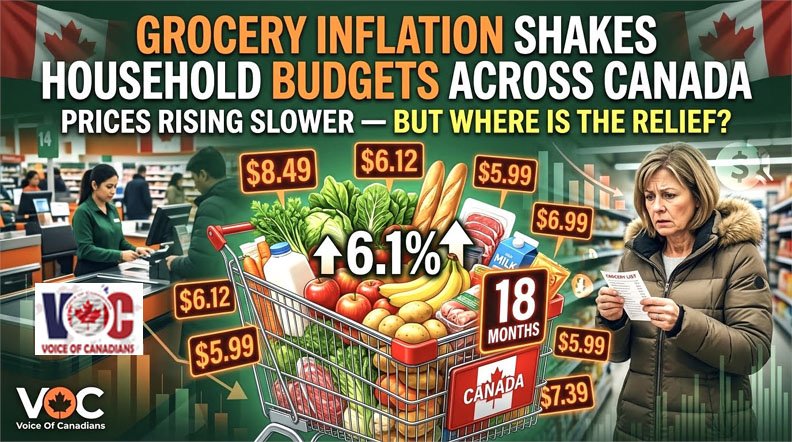
Price Growth Slows, But Where Is the Relief at the Supermarket? — Grocery Inflation Remains Above Overall Inflation for the 18th Consecutive Month, Fresh Fruit Prices Up 6.1%
Report: Mehboob Ali Shaikh
Official inflation data in Canada shows that the pace of grocery price increases has eased somewhat, but for the average Canadian consumer, the rising supermarket bill remains a major challenge.
According to Statistics Canada’s July 2026 data released on August 17, prices for food purchased from stores, or groceries, were 3.1% higher than a year earlier. The annual increase was 3.9% in June.
In other words, groceries have not become cheaper — the pace at which prices are increasing has simply slowed somewhat.
In July 2026, Canada’s overall Consumer Price Index (CPI) increased by 3.0% year over year, up from a 2.8% increase in June.
This means overall inflation accelerated again, while grocery inflation eased slightly. However, the annual increase in grocery prices remained higher than the overall CPI.
July marked the 18th consecutive month in which annual inflation for food purchased from stores was higher than Canada’s overall CPI.
Fresh Fruit Among the Biggest Increases
Price trends varied considerably across different grocery categories.
In July, the pace of annual price increases for fresh vegetables and chicken slowed, while cereal products helped moderate overall grocery inflation.
On the other hand, fresh fruit prices were 6.1% higher than a year earlier.
Between June and July alone, fresh fruit prices increased by 4.7%, with berries and melons among the notable contributors.
Slower Inflation Does Not Mean Cheaper Groceries
There is an important distinction when understanding grocery inflation.
If the price of an item has already increased significantly over several years because of inflation, and its price rises another 3.1% the following year, that does not mean the item has become cheaper.
It simply means that the price is increasing at a slower rate than before.
That is why consumers may hear that “inflation is cooling” in government statistics but still see little immediate relief at the supermarket checkout.
Canadians Are Changing Their Shopping Strategies
Inflation has also forced many consumers to change the way they shop.
Speaking to local media, Halifax shopper Brennan Dempsey said that as food prices have increased, he has adopted several strategies to manage his budget — including shopping at Walmart for lower prices, buying in bulk at Costco, and freezing food so it can be used for longer periods.
He also compares prices at different stores, searches for deals and focuses more on purchasing only essential items.
The situation demonstrates that inflation is no longer simply a matter of statistics. It is also changing the everyday shopping habits of Canadian families.
In a local media shopping exercise, a basket containing common items such as cereal, fruit, pasta, bananas and bread came to $99.67, with the groceries barely fitting into two small bags.
The example illustrates why consumers can experience a noticeable difference between the official inflation rate and their everyday experience at the checkout counter.
Grocery Costs Add to Other Household Expenses
Food prices are rising at a time when Canadian households are already dealing with higher costs for housing, transportation, insurance, utilities and other basic necessities.
Headline inflation reached 3.0% in July, while annual changes in gasoline prices were also among the factors affecting the overall CPI.
As a result, an additional few dollars spent on groceries does not occur in isolation. When higher food costs are combined with housing, transportation and other essential expenses, a household’s disposable income becomes even more limited.
The continued increase in food prices can be particularly challenging for large families, seniors and people living on fixed incomes.
The fact that grocery inflation has remained above overall inflation for 18 consecutive months highlights the continuing financial pressure that food costs place on Canadian household budgets.
The Big Question: When Will Consumers Actually See Relief?
The data shows that the pace of grocery price increases declined from 3.9% in June to 3.1% in July.
But for consumers, the real question is not simply how quickly prices are rising.
The bigger question is: When will grocery bills actually come down?
For now, the answer is clear: inflation has slowed somewhat, but groceries have not become cheaper.
The rising cost of food continues to affect the monthly budgets of millions of Canadian households. For many consumers, the biggest challenge remains finding ways to meet increasing basic expenses while living within limited incomes.
Grocery inflation in Canada may be cooling, but for Canadian families, the supermarket bill is still running hot.