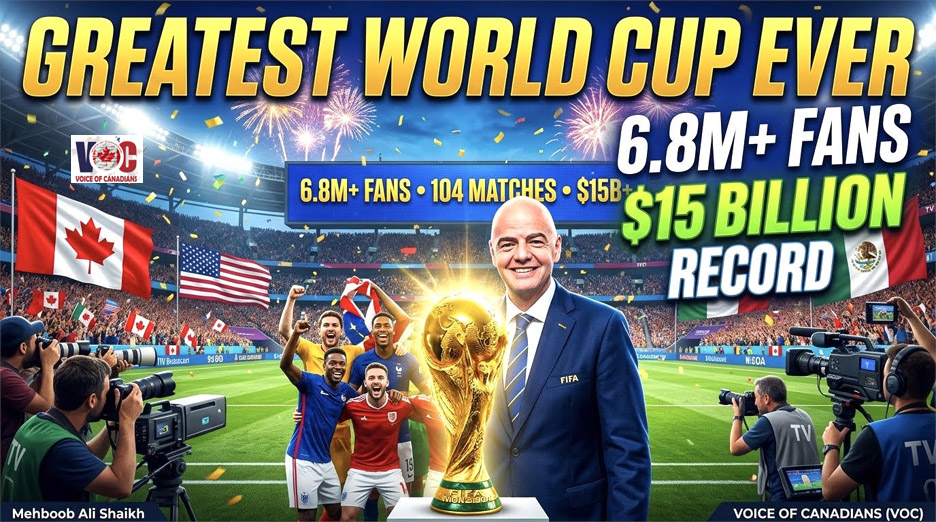
48 teams, 104 matches, and 6,810,966 fans turned the FIFA World Cup 2026 into one of the most unforgettable tournaments in football history. FIFA President Gianni Infantino hailed the competition as a landmark success that will be remembered for generations.
Special Report by Mehboob Ali Shaikh
The FIFA World Cup 2026 has written a remarkable new chapter in global football history. Hosted across 16 cities in the United States, Canada, and Mexico, the tournament has set new benchmarks for success on and off the pitch. FIFA President Gianni Infantino described the event as an unforgettable World Cup that will be remembered for decades, calling it the biggest, most exciting, and most successful edition ever staged.
The largest FIFA World Cup in history concluded with a thrilling final between Spain and Argentina, bringing to an end an extraordinary month of football. Before the tournament began, concerns were raised worldwide over expensive ticket prices, extreme summer heat, geopolitical tensions, security issues, and the expansion to 48 teams. However, those concerns quickly faded as the tournament delivered world-class football, packed stadiums, and unforgettable moments that captivated millions of fans.
From the opening whistle on June 11 to the final kick on July 19, the FIFA World Cup 2026 produced spectacular matches, unforgettable performances, and an electric atmosphere shared by players and supporters from every corner of the globe.
Record-Breaking Revenue and Attendance : The FIFA World Cup 2026 shattered every previous financial record. Initially projected to generate approximately US$11 billion, tournament revenue reportedly surpassed US$15 billion, making it the most commercially successful FIFA World Cup in history.
Across 104 matches, a total of 6,810,966 spectators attended the tournament, while stadiums operated at an average occupancy of approximately 99.7 percent. These remarkable figures firmly place FIFA World Cup 2026 among the greatest sporting events ever organized.
Much of the credit for this historic achievement belongs to FIFA President Gianni Infantino, whose leadership, dedication, and long-term vision played a central role in delivering a tournament of unprecedented scale and success.
Last week, Infantino informed FIFA’s member associations about the tournament’s extraordinary financial performance. FIFA had originally estimated revenues of around US$11 billion, but according to sources, final earnings exceeded expectations by a significant margin.
The major contributors to this financial success were premium hospitality packages and ticket sales, particularly within the secondary resale market, where tickets were sold at exceptionally high prices. FIFA also benefited by collecting 15 percent fees on both ticket purchases and resales, generating substantial additional revenue.
Expansion to 48 Teams Proved a Huge Success: Before the tournament, many football experts questioned whether expanding the World Cup to 48 teams would reduce the quality of competition. Instead, the opposite occurred.
Several debutant and smaller football nations challenged traditional powerhouses with outstanding performances.
Cape Verde held Spain to a scoreless draw before pushing Argentina to extra time in the Round of 32. Curaçao frustrated Ecuador with a disciplined defensive display, while Egypt reached the knockout stage for the first time and came close to eliminating Argentina before Lionel Messi inspired a dramatic comeback.
African football also reached a historic milestone, with a record nine African nations advancing to the knockout rounds, highlighting the continent’s growing strength on the global stage.
Football’s Biggest Stars Delivered
The world’s greatest football stars produced memorable performances throughout the tournament.
Lionel Messi enjoyed an outstanding sixth FIFA World Cup, opening his campaign with a hat-trick against Algeria before finishing the tournament with eight goals.
France captain Kylian Mbappé ended the competition as the leading scorer with ten goals, further strengthening his place among the greatest goalscorers in FIFA World Cup history.
Norway’s Erling Haaland scored seven goals, including a memorable brace against Brazil, while England’s Jude Bellingham also netted seven times, and Harry Kane added six goals as England secured third place.
All Three Host Nations Reached the Knockout Stage
All three co-hosts Canada, the United States, and Mexico successfully advanced to the knockout rounds.
In Canada, FIFA Fan Festivals attracted thousands of supporters across cities including Toronto, while football’s popularity continued to grow nationwide, transforming the tournament into a truly national celebration.
The FIFA World Cup extended far beyond stadiums. Streets, cafés, public squares, and fan zones across the host cities overflowed with football supporters from around the world.
Scottish supporters in Boston, Norwegian fans in New York’s Times Square, and international visitors throughout the United States shared their experiences of American culture, giant supermarkets, barbecue traditions, and local hospitality across social media, adding another dimension to the global celebration.
Controversies Also Drew International Attention
Although the football was outstanding, several controversies attracted worldwide attention. Somali referee Omar Artan was reportedly unable to enter the United States because of immigration policy issues. Iran’s national team faced visa-related restrictions that required the squad to leave the United States immediately after each match. Head coach Amir Ghalenoei described Iran as “the most affected team of the tournament.”
The most debated controversy came during the Egypt-Argentina match, where several refereeing decisions against Egypt sparked accusations of bias. Another widely criticized issue involved the postponement of American forward Folarin Balogun’s one-match suspension, which generated significant international debate.
Football Once Again United the World: The FIFA World Cup 2026 demonstrated that despite political disagreements, economic uncertainty, and security concerns, sport continues to possess an extraordinary ability to unite nations.
The expansion to 48 teams proved successful, emerging football nations made significant progress, African football reached new heights, attendance records were broken, and the overall standard of football remained exceptionally high.
Overall, FIFA World Cup 2026 has earned its place among the greatest sporting events in FIFA history and will be remembered as a remarkable celebration of football, culture, diversity, and global unity.
Looking Toward the Future : The tournament has further strengthened the leadership of FIFA President Gianni Infantino. Regional football confederations across Africa, Asia, and South America have already expressed support for his leadership ahead of the 2027 FIFA presidential election.
Meanwhile, FIFA is seriously considering a proposal to expand the 2030 FIFA World Cup to 64 teams, with important decisions expected in the coming years.
Gianni Infantino’s Message to Football Fans
Celebrating the success of FIFA World Cup 2026, FIFA President Gianni Infantino said that I sincerely thank every fan who filled our stadiums with passion, love, and incredible energy. Together, you created unforgettable memories that will live forever in FIFA World Cup history. You made this global celebration truly unique and once again proved that football has the magical power to unite the entire world as one family.