Discussions Focus on the Possibility of Tariff-Free Trade Across North America
By Mehboob Ali Shaikh
Ontario Premier Doug Ford is on a high-profile visit to Washington, D.C., where he is meeting with business leaders, agricultural representatives, and automotive industry stakeholders to promote stronger economic cooperation and freer trade between Canada and the United States.
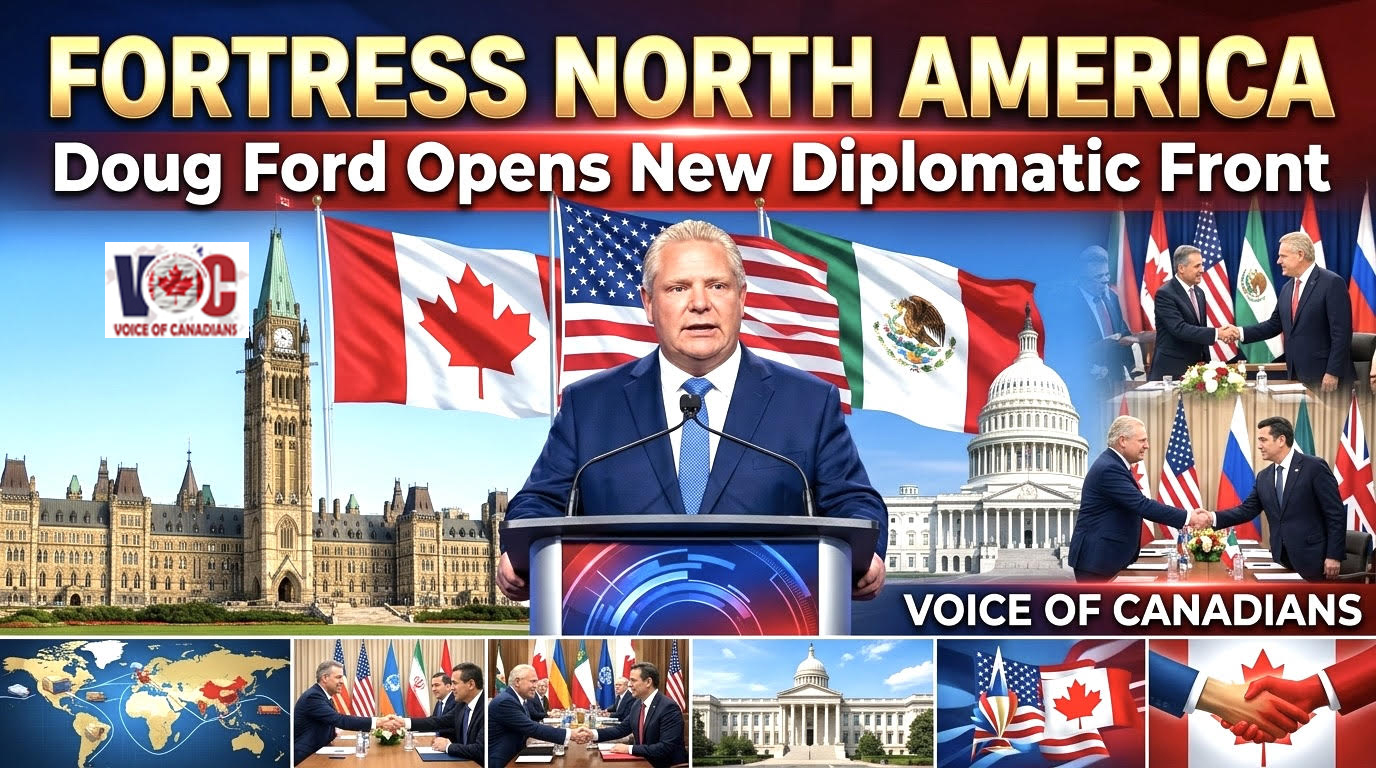
At the center of Ford’s diplomatic mission is his vision of “Fortress North America,” an initiative aimed at strengthening economic growth, investment, job creation, and regional security across Canada, the United States, and Mexico.
According to analysts, if the concept gains momentum, it could unlock significant economic opportunities for Ontario and the rest of Canada. However, political and trade-related challenges remain substantial.
A Vision for a More Integrated North America
Premier Ford’s two-day visit to Washington is focused on reinforcing trade relations among the three North American partners. While many of the meetings have been held behind closed doors, available information suggests that this is far more than a routine political visit. Instead, it represents a broader diplomatic effort tied to the future economic direction of the continent.
For several months, Ford has promoted the idea of “Fortress North America,” which envisions a more integrated economic and security partnership among Canada, the United States, and Mexico.
Under the proposal:
- Trade barriers and tariffs would be reduced across North America.
- Manufacturing and production costs would decline.
- New jobs and investment opportunities would be created.
- The region’s economic competitiveness would be strengthened against global rivals such as China.
- Cooperation on border security and continental defense would be enhanced.
According to the Ontario government, the initiative is intended to serve as a long-term continental economic strategy rather than simply a trade agreement.
Meetings in Washington
Ford began his visit at the Canadian Embassy in Washington, where he met with Canada’s Ambassador to the United States, Mark Wiseman, and Ontario Minister of Economic Development, Job Creation and Trade, Vic Fedeli.
During the meeting, participants discussed the prospects of “tariff-free trade” across North America and explored ways to deepen economic integration between the continent’s major trading partners.
A photograph shared by Ford on social media, showing him with the U.S. Capitol in the background, has been widely interpreted in political circles as a symbolic message underscoring the importance of the mission.
Throughout his visit, Ford has scheduled meetings with representatives from the automotive industry, agricultural organizations, business groups, and senior members of the U.S. Congress.
These sectors play a crucial role in the billions of dollars in trade that flow between Canada and the United States each year. Ontario’s automotive manufacturing industry and agricultural exports are particularly dependent on access to the American market, making tariffs and trade disputes a major concern for jobs and economic growth.
Ford also met with representatives of Auto Drive America, the American Farm Bureau Federation, and the American Automotive Policy Council.
Sources indicate that one of the primary objectives of these discussions is to reinforce the message that Canada and the United States are economic partners—not competitors.
Navigating a Complex Political Relationship
Relations between Premier Ford and U.S. President Donald Trump have not always been smooth.
In the past, Trump suspended trade discussions with Canada, prompting Ford to release a controversial advertisement referencing former U.S. President Ronald Reagan. More recently, Ford criticized Trump over remarks suggesting Canada could become the “51st state” of the United States.
Despite these tensions, Ford’s current approach emphasizes economic cooperation rather than political confrontation.
According to David Paterson, Ontario’s representative in Washington, Ford’s business background and conservative political philosophy resonate with many Republican policymakers in the United States.
“Doug Ford believes in business growth, economic development, and lower taxes,” Paterson said. “Those priorities align with the thinking of many American decision-makers, which is why he is viewed as an effective voice for Ontario in Washington.”
Potential Economic Benefits
Experts believe that if the Fortress North America vision succeeds, the benefits could include:
- Increased investment across North America.
- Construction of new manufacturing facilities.
- Creation of thousands of jobs.
- Greater stability for the automotive sector.
- Growth in agricultural exports.
- Lower prices for consumers.
However, analysts caution that significant obstacles remain, including:
- U.S. domestic political pressures.
- Protectionist trade policies.
- Economic competition with China.
- Border and security concerns.
- Diverging economic priorities between Canada and the United States.
As a result, the path toward deeper integration is expected to be complex and politically challenging.
Looking Ahead
Observers note that Ford’s Washington visit represents more than a series of meetings—it reflects a broader economic vision for North America.
The concept of “Fortress North America” highlights an ongoing debate about how Canada, the United States, and Mexico can leverage their collective economic strength in an increasingly competitive global marketplace.
Ultimately, the visit seeks to answer a critical question: Can North America evolve into a more integrated economic bloc capable of competing more effectively on the world stage?
The answer may shape the future of trade, investment, and economic cooperation across the continent for years to come.