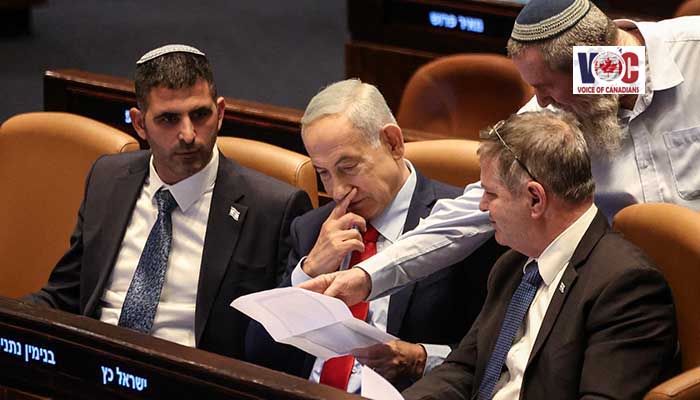
With national elections on the horizon, Israel’s confrontation with Iran has presented Prime Minister Benjamin Netanyahu with a potential opportunity to repair a political standing badly damaged by the October 7, 2023 attack from Gaza, according to political analysts.
Whether the conflict ultimately strengthens his position, however, will depend largely on its trajectory and duration.
A day after Iran’s Supreme Leader, Ali Khamenei, was killed in coordinated US-Israeli strikes, Netanyahu credited Israel’s close coordination with Washington for enabling what he described as a long-held strategic objective: delivering a decisive blow to Tehran.
The aftermath of the October 7 assault significantly eroded public confidence in Netanyahu’s leadership. Critics accused him of attempting to deflect responsibility for what became the deadliest day in Israel’s history, arguing that intelligence and security failures went unaddressed at the highest levels.
Now 76, the leader of the right-wing Likud party is Israel’s longest-serving premier, having accumulated more than 18 years in office across multiple terms. Renowned for his political durability, Netanyahu has nevertheless governed without a stable parliamentary majority since the summer, amid tensions with his ultra-Orthodox coalition partners.
Complicating matters further, he remains on trial in a protracted corruption case and has reportedly sought a presidential pardon. US President Donald Trump has publicly urged Israeli President Isaac Herzog to consider granting clemency.
Electoral Calculations
Under Israeli law, elections must be held by October 27 at the latest. Some observers believe Netanyahu may opt for an early poll.
Emmanuel Navon, a political scientist at Tel Aviv University, argues that the prime minister is unlikely to wait until late October, particularly given the symbolic weight of the October 7 anniversary. In his assessment, Netanyahu has gradually recovered from what appeared to be a political nadir following the Gaza attack.
Recent opinion surveys suggest that a Likud-led bloc would finish first if elections were held today, potentially positioning Netanyahu to form the next government. However, even under current projections, his existing allies would fall short of an outright majority.
Analysts contend that a decisive military success against Iran could alter that arithmetic.
Michael Horowitz, an independent geopolitical analyst, said the offensive reinforces the image Netanyahu has long sought to project — one encapsulated in his slogan of “total victory.” Demonstrating tangible results, Horowitz argued, would allow Netanyahu to frame the campaign not merely as rhetoric but as a realised national strategy central to his electoral appeal.
Risks of Prolonged Conflict
Not all commentators are convinced. Raviv Druker of Channel 13 television suggested that Netanyahu would seek to portray the outcome as a comprehensive triumph regardless of the facts on the ground, noting that Hamas continues to wield influence in Gaza and that Iran’s strategic posture may remain largely intact despite recent strikes.
On the news platform Walla, journalist Ouriel Deskal speculated that the timing of hostilities could also carry domestic political implications. A state of emergency could automatically delay the March 30 deadline for passing a national budget — legislation Netanyahu has struggled to secure through parliament. Failure to pass the budget would otherwise trigger the government’s collapse and prompt elections, potentially forcing him into a campaign from a weakened position.
For now, much hinges on the war’s progression. While a swift and clearly defined success could bolster Netanyahu’s standing, a drawn-out conflict may prove politically costly.
Horowitz cautioned that public tolerance for prolonged warfare — especially if accompanied by mounting casualties and economic strain — remains limited. During last June’s hostilities, Iranian missile strikes killed 30 people in Israel. Since the latest escalation, additional fatalities have been reported following retaliatory attacks.
He added that while Israel’s military achievements are often credited to the armed forces and civilian resilience, such gains do not automatically translate into personal political capital for the prime minister. “The army’s popularity is rising,” he observed, “not necessarily Netanyahu’s.”